


OMIM ID:
Crouzon Syndrome
Alternate Names
Defective Genes
Clinical Characteristics
Ocular Features
The primary ocular features result from pattern-specific, premature synostoses of cranial sutures. The orbits are often shallow resulting in proptosis, sometimes to such an extent that exposure keratitis or even spontaneous subluxation of the globe results. This is exacerbated by the midface hypoplasia that is often present. As many as 22% of patients have optic atrophy, most likely secondary to chronic papilledema from elevated intracranial pressure. Strabismus is common, often with a V-pattern exotropia. Overaction of the inferior obliques and underaction of the superior obliques have been described. One patient with narrow angle glaucoma has been reported.
Systemic Features
The coronal sutures are the most commonly affected by the premature synostosis and hence the skull is often brachycephalic and the forehead is prominent. Increased intracranial pressure is a risk. The nose is parrot-beaked and the upper lip is short. Maxillary hypoplasia from the midface underdevelopment can cause crowding and displacement of the upper teeth.
Genetics
Inheritance
This type of craniosynostosis is caused by mutations in the fibroblast growth factor receptor-2 gene, FGFR2, located at 10q26. It is generally considered an autosomal dominant disorder based on familial cases but most occur sporadically. A paternal age effect on mutations has been found.
The same gene is mutant in other craniosynostosis disorders sometimes clinically separated such as Pfeiffer Syndrome (101600), Jackson-Weiss syndrome (123150), Beare-Stevenson Syndrome (123790), Apert Syndrome (101200), and Saethre-Chotzen Syndrome (101400). However, this entire group has many overlapping features making classification on clinical grounds alone difficult. Only Apert syndrome (101200) is caused by a unique mutation whereas other syndromes seem to owe their existence to multiple mutations.
Pedigree
Autosomal dominant
Autosomal dominant disorders require only one mutation for the disease to be expressed. Since an affected parent has two chromosomes, only one of which has the mutant gene, parents can expect that half (50%) of their children will receive that one and inherit the disease. It is common for individuals that inherit the mutation, however, to not have evidence of the disease (nonpenetrance).
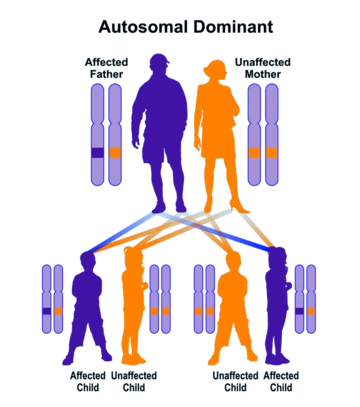
Autosomal dominant inheritance leads to a vertical pattern of transmission