


OMIM ID:
Beare-Stevenson Syndrome
Alternate Names
Defective Genes
Clinical Characteristics
Ocular Features
The midface hypoplasia and shallow orbits result in the appearance of prominent eyes. Ptosis and hypertelorism have been reported while the palpebral fissures are downslanting. One patient has been reported to have optic atrophy. Another patient was described with cloudy corneas, irregular irides and nonreactive pupils.
Systemic Features
Pregnancies may be complicated by polyhydramnios. Infants are born with craniosynostosis with a cloverleaf pattern usually. The skull is often shortened in the anteroposterior axis with flattening of the occipital region. The skin is deeply furrowed with the cutis gyrata patterns most prominent in the posterior scalp but also present on the palms, soles, pinnae, and elsewhere. Acanthosis nigricans is often present.
There is midface hypoplasia and nearly all individuals have intellectual disability.
The external ear canals can be atretic, the nares are often anteverted, and the mouth may be small. An excess number of neonatal teeth and hypoplastic nails have been noted. Hydrocephalus is common. The umbilical stump is often unusually prominent. Anogenital anomalies such as an anteriorly placed anus, cryptorchidism, and bifid scrotum may be present. Pyloric stenosis is sometimes present.
Upper airway obstruction with respiratory distress may necessitate a tracheotomy. A cartilaginous tracheal sleeve replacing the normal C rings of cartilage has been found in several infants. These can be difficult to detect and their presence may have been responsible for breathing restrictions that has led to the demise of some children before two years of age.
Genetics
Inheritance
Reported cases have occurred sporadically. Increased paternal age has been suggested as a factor in the occurrence of heterozygous mutations in the FGFR2 gene (10q26.13) which have been identified in some individuals.
Other forms of craniosynostosis in which mutations in FGFR2 have been found are: Crouzon Syndrome (123500), Pfeiffer Syndrome (101600), Apert Syndrome (101200), Jackson-Weiss Syndrome (123150), and Saethre-Chotzen Syndrome (101400).
Pedigree
Autosomal dominant
Autosomal dominant disorders require only one mutation for the disease to be expressed. Since an affected parent has two chromosomes, only one of which has the mutant gene, parents can expect that half (50%) of their children will receive that one and inherit the disease. It is common for individuals that inherit the mutation, however, to not have evidence of the disease (nonpenetrance).
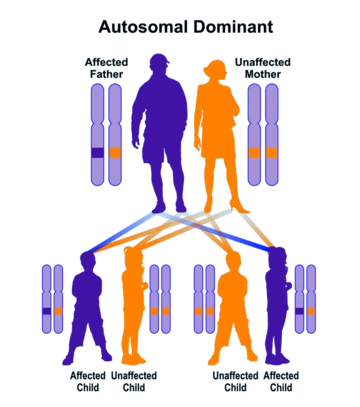
Autosomal dominant inheritance leads to a vertical pattern of transmission