


OMIM ID:
Jackson-Weiss Syndrome
Alternate Names
Defective Genes
Clinical Characteristics
Ocular Features
The facial malformation such as the flattened midface with maxillary hypoplasia leads to shallow orbits with the result that the eyes appear proptotic. Some but not all individuals have strabismus, usually exotropia. Optic atrophy has not been reported.
Systemic Features
Infants usually present at birth with skull deformities resembling some variant of acrocephalosyndactyly. Some or all of the skull sutures may be fused. In some individuals craniectomy is necessary while others have normal brain development. Few patients have evidence of abnormal neurological development and psychometric testing reveals IQ’s in the normal range. The midface is flattened with sometimes severe maxillary hypoplasia. No hand deformities are present.
There may be cutaneous syndactyly of the second and third toes. Variable tarsal fusion is often present. The great toe may be abnormally broad and deviated medially. The first metatarsals and proximal phalanges of the great toes are generally broad.
The phenotype is highly variable and even among individuals in genetically more homogeneous populations such as the Old Order Amish the range of facial, skull, and digital anomalies include features found among all of the craniosynostosis syndromes except for Apert syndrome.
Genetics
Inheritance
Heterozygous mutations in the FGFR2 gene (10q26.13) are likely responsible for this autosomal dominant condition.
Other forms of craniosynostosis in which mutations in FGFR2 have been found are: Beare-Stevenson Syndrome (123790), Crouzon Syndrome (123500), Pfeiffer Syndrome (101600), Apert Syndrome (101200), and Saethre-Chotzen Syndrome (101400).
Pedigree
Autosomal dominant
Autosomal dominant disorders require only one mutation for the disease to be expressed. Since an affected parent has two chromosomes, only one of which has the mutant gene, parents can expect that half (50%) of their children will receive that one and inherit the disease. It is common for individuals that inherit the mutation, however, to not have evidence of the disease (nonpenetrance).
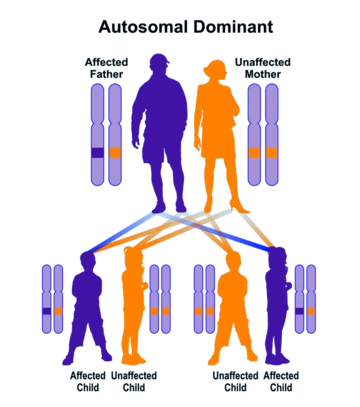
Autosomal dominant inheritance leads to a vertical pattern of transmission