


OMIM ID:
Saethre-Chotzen Syndrome
Alternate Names
Defective Genes
Clinical Characteristics
Ocular Features
The lids are often ptotic and asymmetrically so in keeping with the skull asymmetry. Strabismus is common. Optic atrophy, downward slanting lid fissures, epicanthal folds, and dacryostenosis have also been reported.
Systemic Features
The skull is acrocephalic and asymmetrical. The frontal hairline is low. The external ear and especially the crus of the ear are malformed and the latter is sometimes considered a valuable diagnostic sign. There is frequently mild soft tissue syndactyly of the third, fourth and fifth toes, and the distal phalanges of the hallux may be bifid. Syndactyly of the fingers is sometimes present as well. Clefting of the soft and hard palates is commonly present and a few patients have had joint contractures. Hearing loss of all types has been reported. Mental development seems to be normal. An increased risk of breast cancer has been found among Swedish patients.
SCS is considered to be one of the more common types of syndromic craniosynostosis.
Genetics
Inheritance
Saethre-Chotzen syndrome is caused by mutations in the TWIST1 (10q26) and possibly FGFR2 genes suggesting genetic heterogeneity. There is also a great deal of clinical heterogeneity. This syndrome is sometimes confused with Gorlin-Chaudhry-Moss syndrome (233500). Pedigrees are consistent with autosomal dominant inheritance.
Pedigree
Autosomal dominant
Autosomal dominant disorders require only one mutation for the disease to be expressed. Since an affected parent has two chromosomes, only one of which has the mutant gene, parents can expect that half (50%) of their children will receive that one and inherit the disease. It is common for individuals that inherit the mutation, however, to not have evidence of the disease (nonpenetrance).
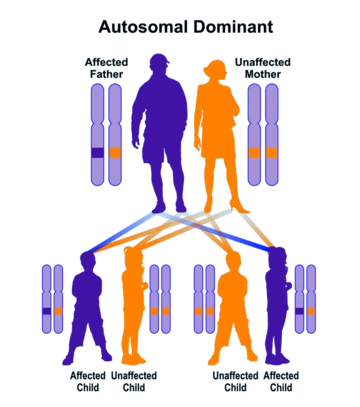
Autosomal dominant inheritance leads to a vertical pattern of transmission