


OMIM ID:
Singleton-Merten Syndrome 1
Alternate Names
Defective Genes
Clinical Characteristics
Ocular Features
Several children have been diagnosed with glaucoma in early childhood or during puberty. Glaucoma surgery has been beneficial in some but visual damage may be severe.
Systemic Features
Patients have early-onset calcifications of the aorta and of the aortic and mitral valves which may be seen in childhood and can be responsible for heart failure and early death. Osteoporosis of the limbs and widened medullary cavities have been seen. Abnormal bone mineralization and extends to the jaws leading to tooth loss and early-onset periodontal disease. Eruption of both primary and permanent teeth is delayed but tooth roots can be truncated as well. The hips dislocate easily due to shallow acetabulae and patients are susceptible to tendon tears.
Hypotonia and generalized weakness may be present which is sometimes exacerbated following a febrile illness. The skin may be dry and scaly consistent with psoriasis and there may be photosensitivity.
The forehead is broad and prominent and the hairline is high and anterior. The philtrum is smooth and the upper vermilion is thin.
Genetics
Inheritance
Heterozygous mutations in the IFIH1 gene (2q24.2) are responsible for this disorder. Another form of Singleton-Merten Syndrome (SGMRT2; 609631) is the result of mutations in the DDX58 gene.
Pedigree
Autosomal dominant
Autosomal dominant disorders require only one mutation for the disease to be expressed. Since an affected parent has two chromosomes, only one of which has the mutant gene, parents can expect that half (50%) of their children will receive that one and inherit the disease. It is common for individuals that inherit the mutation, however, to not have evidence of the disease (nonpenetrance).
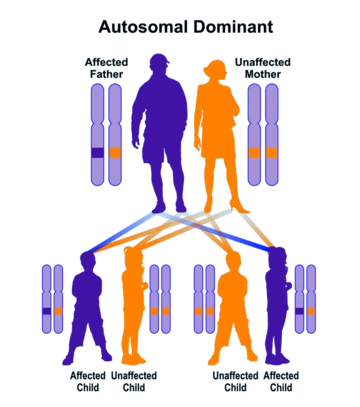
Autosomal dominant inheritance leads to a vertical pattern of transmission