


OMIM ID:
Congenital Heart Defects, Dysmorphic Facies, and Intellectual Developmental Disorder
Alternate Names
Defective Genes
Clinical Characteristics
Ocular Features
The dysmorphic facial features primarily involve the periocular structures. These include hypertelorism, ptosis, epicanthal folds, strabismus and upslanted palpebral fissures.
Systemic Features
Septal defects involving both the atrium and the ventricle are consistently present. Pulmonary valve abnormalities are present in some patients.
Posteriorly rotated pinnae and a small mouth with a thin upper lip have been observed. Camptodactyly and clinodactyly are common. Some patients have mild microcephaly.
Global developmental delay is a consistent feature manifest as delays in walking and speech and eventual intellectual disability. Feeding difficulties are common. Hypotonia and hypermobile joints are often noted. Imaging of the brain may reveal agenesis of the corpus callosum, incomplete formation of the inferior vermis, and leukomalacia of periventricular tissue.
Genetics
Inheritance
Heterozygous mutations have been identified in the CDK13 gene (7p14.1) in seven unrelated individuals. Heterozygous parents may not have the full phenotype.
Pedigree
Autosomal dominant
Autosomal dominant disorders require only one mutation for the disease to be expressed. Since an affected parent has two chromosomes, only one of which has the mutant gene, parents can expect that half (50%) of their children will receive that one and inherit the disease. It is common for individuals that inherit the mutation, however, to not have evidence of the disease (nonpenetrance).
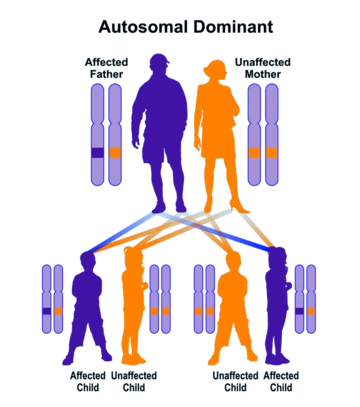
Autosomal dominant inheritance leads to a vertical pattern of transmission