


Congenital Heart Defects, Dysmorphic Facies, and Intellectual Developmental Disorder
Patient Information
Characteristics
Background and History
There are many congenital and developmental conditions resulting from gene changes (mutations). Each mutation usually results in a more or less characteristic clinical syndrome but there is often considerable overlap. This disorder is manifest primarily in heart and facial anomalies.
Clinical Correlations
Defects in the internal heart walls are consistently present. Sometimes the pulmonary heart valve is anomalous as well. The eyelids droop (ptosis), the eyes are often misaligned (strabismus) and appear wide apart, the mouth is small, the lid openings slant upwards, and the ears are rotated posteriorly. In a few patients, the skull is smaller than normal.
General development is delayed as manifest by delays in speech and walking and in general intellectual functioning. Muscle tone is often decreased resulting in generalized ‘floppiness’ and joint hypermobility. Feeding difficulties are common.
Imaging of the brain reveals widespread developmental abnormalities.
Genetics
Inheritance
This disorder results from a single mutation (change) in a specific gene which usually arises de novo since those who carry the change do not reproduce. The gene configuration suggests autosomal dominant inheritance as the most likely transmission pattern.
Pedigree
Autosomal dominant
Autosomal dominant disorders require only one mutation for the disease to be expressed. Since an affected parent has two chromosomes, only one of which has the mutant gene, parents can expect that half (50%) of their children will receive that one and inherit the disease. It is common for individuals that inherit the mutation, however, to not have evidence of the disease (nonpenetrance).
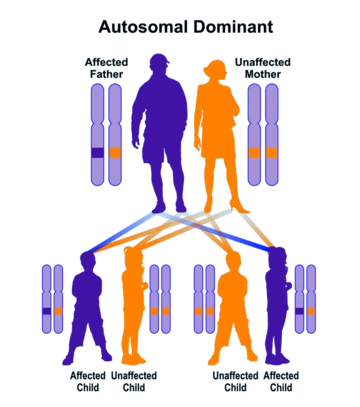
Autosomal dominant inheritance leads to a vertical pattern of transmission
Diagnosis and Prognosis
The diagnosis is based on the unique pattern of anomalies although each of these individually are not diagnostic. No treatment is known and supportive care is required. There are no data on longevity.
Printer Friendly Version: Ctrl/Cmd+P