


Clinical Characteristics
Ocular Features
This is a disorder of the cornea and anterior chamber that is sometimes considered to be a form of anterior segment or mesenchymal dysgenesis. The primary feature is corneal clouding, most prominent peripherally and extending to the central cornea to a variable extent. Vascular arcades are usually present over the area of clouding and there is no clear limbal demarcation. Corneal fibers are often disorganized and larger than normal. The anterior chamber may appear shallow and the iris usually has a flat appearance, often with a posterior embryotoxon. Iris processes to the cornea and anterior synechiae are frequently present. Some degree of microcornea has also been noted in many cases. Rotary and horizontal nystagmus are uncommon. Sclerocornea may be a feature of cornea plana as well and the distinction between these disorders is unclear, especially in reported dominant pedigrees in which hyperopia is a feature.
Most cases are bilateral but there is often considerable asymmetry between the two eyes. Visual acuity is dependent on the extent of corneal opacification but may be normal. It is not a progressive disease.
Systemic Features
No systemic abnormalities have been reported. However, sclerocornea can be a feature of numerous somatic and chromosomal disorders (e.g., oculocerbral syndrome with hypopigmentation (257800 ).
Genetics
Inheritance
No DNA mutations have as yet been found. Most cases occur sporadically, and others are part of anterior chamber dysgenesis disorders. However, rare autosomal dominant pedigrees have been reported in which the degree of opacification and anterior chamber anomalies are not as severe as those in which the pattern is most consistent with autosomal recessive inheritance.
Pedigree
Autosomal dominant
Autosomal dominant disorders require only one mutation for the disease to be expressed. Since an affected parent has two chromosomes, only one of which has the mutant gene, parents can expect that half (50%) of their children will receive that one and inherit the disease. It is common for individuals that inherit the mutation, however, to not have evidence of the disease (nonpenetrance).
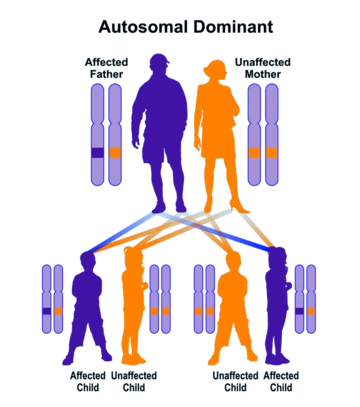
Autosomal dominant inheritance leads to a vertical pattern of transmission
Autosomal recessive
In order for autosomal recessive disorders to be expressed, offspring generally must inherit two mutations, one from each carrier parent. Carriers with only one mutation, such as the parents, do not have clinical disease. Note that carrier parents can expect that 1 in 4 children (25%) will inherit both mutations and have the disorder, 2 in 4 children (50%) will be carriers like their parents, while 1 in 4 children (25%) inherit neither mutation.

In order for autosomal recessive disorders to be expressed, offspring generally must inherit two mutations, one from each carrier parent. Carriers with only one mutation, such as the parents, do not have clinical disease. Note that carrier parents can expect that 1 in 4 children (25%) will inherit both mutations and have the disorder, 2 in 4 children (50%) will be carriers like their parents, while 1 in 4 children (25%) inherit neither mutation.