


Sclerocornea
Patient Information
Characteristics
Background and History
Sclerocornea is a congenital malformation disorder in which the cornea and other aspects of the front part of the eye do not develop normally. The features may occur as an isolated entity but may also be part of a several more generalized syndromes.
Clinical Correlations
The cardinal feature of sclerocornea is clouding of the cornea to a variable degree. The cornea, the clear front part of the eye, functions as the ‘windshield’ to allow light to enter. Of course, it needs to be clear to function properly but as a result of disease or injury may become cloudy. In sclerocornea, the cloudiness is variable, and often vision is normal or near normal. In other cases it is sufficiently opaque that light is obstructed in which case vision may be subnormal. An eye doctor needs to examine other parts of the eye since the iris may be abnormal as well which sometimes results in glaucoma. In simple sclerocornea, no other parts of the body are affected
Genetics
Inheritance
Sclerocornea is rare and few families have been reported. Most cases occur sporadically without a family history but others can occur in which the inheritance pattern is either autosomal recessive or dominant. The former results in families when multiple members of a single sibship are affected and the parents may be related to each other. These cases tend to have more severe disease than those that are found in rare families in which the disorder occurs in consecutive generations (autosomal dominant).
Sclerocornea may also be found in association with several other hereditary eye diseases.
Pedigree
Autosomal dominant
Autosomal dominant disorders require only one mutation for the disease to be expressed. Since an affected parent has two chromosomes, only one of which has the mutant gene, parents can expect that half (50%) of their children will receive that one and inherit the disease. It is common for individuals that inherit the mutation, however, to not have evidence of the disease (nonpenetrance).
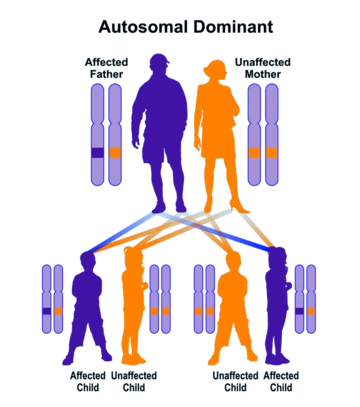
Autosomal dominant inheritance leads to a vertical pattern of transmission
Autosomal recessive
In order for autosomal recessive disorders to be expressed, offspring generally must inherit two mutations, one from each carrier parent. Carriers with only one mutation, such as the parents, do not have clinical disease. Note that carrier parents can expect that 1 in 4 children (25%) will inherit both mutations and have the disorder, 2 in 4 children (50%) will be carriers like their parents, while 1 in 4 children (25%) inherit neither mutation.

In order for autosomal recessive disorders to be expressed, offspring generally must inherit two mutations, one from each carrier parent. Carriers with only one mutation, such as the parents, do not have clinical disease. Note that carrier parents can expect that 1 in 4 children (25%) will inherit both mutations and have the disorder, 2 in 4 children (50%) will be carriers like their parents, while 1 in 4 children (25%) inherit neither mutation.
Diagnosis and Prognosis
The disorder is suspected when simple inspection reveals loss of corneal clarity. Only an eye specialist can determine if this is sclerocornea and not another disorder such as congenital glaucoma. A complete eye examination is important to determine if glaucoma or other eye disease is present. In severe cases, a corneal transplant can improve vision, and, of course, it is important to treat glaucoma if present. This is not a progressive disorder.
Web Resources
Printer Friendly Version: Ctrl/Cmd+P