


OMIM ID:
Nystagmus 3, Congenital, AD
Alternate Names
Defective Genes
Clinical Characteristics
Ocular Features
The nystagmus is horizontal in type and accentuated by fixation and decreased by convergence. It also increases during smooth pursuit and by lateral gaze. There may be components of jerk, circular, and pendular nystagmus. The nystagmus may be present at birth.
Systemic Features
No systemic disease is present.
Genetics
Inheritance
No specific mutation has been found but 3 individuals in one family shared a haplotype suggesting a locus at 7p11.2. The pedigree pattern suggests autosomal dominant inheritance. A four generation family with male to male transmission and a balanced 7;15 translocation has been reported with a similar phenotype.
Other forms of congenital nystagmus transmitted in a similar autosomal pattern are: NYS2, NYS4, and NYS7.
X-linked recessive transmission patterns have also been identified for congenital nystagmus: NYS1, NYS5, and NYS6.
Pedigree
Autosomal dominant
Autosomal dominant disorders require only one mutation for the disease to be expressed. Since an affected parent has two chromosomes, only one of which has the mutant gene, parents can expect that half (50%) of their children will receive that one and inherit the disease. It is common for individuals that inherit the mutation, however, to not have evidence of the disease (nonpenetrance).
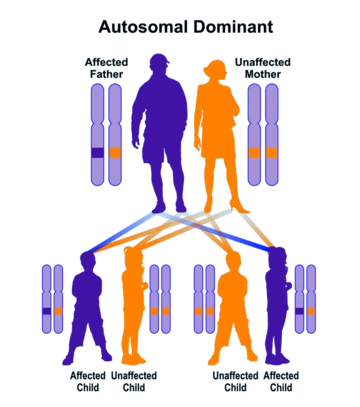
Autosomal dominant inheritance leads to a vertical pattern of transmission