


OMIM ID:
Myopathy, Mitochondrial Anomalies, and Ataxia
Alternate Names
Defective Genes
Clinical Characteristics
Ocular Features
Ocular findings are variable. One of three individuals with compound heterozygous mutations had a pigmentary retinopathy with pallor of the optic nerve but no visual abnormalities. Her sister had only optic nerve pallor. The eyes are described as “small” and “close-set”.
No ocular findings were reported for the family with autosomal dominant inheritance.
Systemic Features
Ataxia, short stature, and gait difficulties from an early age are consistent findings. Some patients are never able to walk. Motor development is generally delayed. Truncal and limb ataxia is a feature. Some degree of intellectual disability is generally present and speech is often delayed.
The face is long with a myopathic appearance. Both micrognathia and a prominent jaw may be seen. The palate is highly arched. Patients are described as hypotonic and there is generalized muscle weakness both proximal and distal. Distal sensory impairment has been described in the family with presumed dominant inheritance and there may be psychiatric symptoms of anxiety, depression, and schizophrenia. Dysmetria with dysdiadochokinesis is often present and a fine intention tremor has been observed.
Mitochondria in fibroblasts exhibit abnormal dynamics and occur in a fragmented network. Muscle biopsies reveal changes consistent with myopathy. Serum creatine kinase may be elevated.
Genetics
Inheritance
Compound heterozygous mutations in the MSTO1 gene (1q22) have been found in two families with 3 affected individuals suggesting autosomal recessive inheritance. In a third family, heterozygous mutations in the same gene were found in a mother and 3 of her adult children, consistent with autosomal dominant transmission.
Pedigree
Autosomal dominant
Autosomal dominant disorders require only one mutation for the disease to be expressed. Since an affected parent has two chromosomes, only one of which has the mutant gene, parents can expect that half (50%) of their children will receive that one and inherit the disease. It is common for individuals that inherit the mutation, however, to not have evidence of the disease (nonpenetrance).
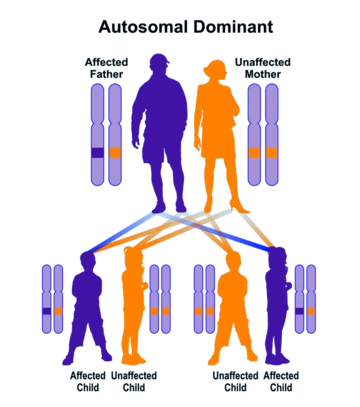
Autosomal dominant inheritance leads to a vertical pattern of transmission
Autosomal recessive
In order for autosomal recessive disorders to be expressed, offspring generally must inherit two mutations, one from each carrier parent. Carriers with only one mutation, such as the parents, do not have clinical disease. Note that carrier parents can expect that 1 in 4 children (25%) will inherit both mutations and have the disorder, 2 in 4 children (50%) will be carriers like their parents, while 1 in 4 children (25%) inherit neither mutation.

In order for autosomal recessive disorders to be expressed, offspring generally must inherit two mutations, one from each carrier parent. Carriers with only one mutation, such as the parents, do not have clinical disease. Note that carrier parents can expect that 1 in 4 children (25%) will inherit both mutations and have the disorder, 2 in 4 children (50%) will be carriers like their parents, while 1 in 4 children (25%) inherit neither mutation.