


Clinical Characteristics
Ocular Features
Superficial punctate keratopathy leads to recurrent corneal erosions and eventually scarring and neovascularization. Progressive opacification requiring PK often occurs. These individuals may also suffer loss of eyebrows and eyelashes with trichiasis and thickening of the lid margins. Corneal erosions and keratoconjunctivitis sicca cause incapacitating symptoms.
Systemic Features
The skin may be diffusely erythematous and scaly. This often becomes patchier with well-demarcated areas especially in skin folds of the neck, axillae, and groin. Older patients with likely autosomal recessive disease have hepatomegaly and may suffer cirrhosis and liver failure. Short stature and mental retardation have also been noted. The hearing loss is neurosensory in type. Epidermal glycogen deposition has been found in one patient with the presumed recessive disorder.
In the presumed autosomal dominant disease, growth failure, mental retardation and liver disease do not seem to be present. However, oral and skin squamous cell carcinomas, as well as malignant pilar tumors of the scalp may lead to early death.
Genetics
Inheritance
It is uncertain if one or more entities are represented by the KID syndrome. Many cases are sporadic but others seem to be transmitted in autosomal recessive or autosomal dominant patterns. The locus of the mutation is unknown in the recessive form. In the dominant form, a mutation has been found in the connexin-26 gene, GJB2, gene located at 13q12.11.
See Hereditary Mucoepithelial Dysplasia (158310) for a somewhat similar but unique genodermatosis. Another is IFAP (308205) but cataracts and hearing loss are not features.
Pedigree
Autosomal dominant
Autosomal dominant disorders require only one mutation for the disease to be expressed. Since an affected parent has two chromosomes, only one of which has the mutant gene, parents can expect that half (50%) of their children will receive that one and inherit the disease. It is common for individuals that inherit the mutation, however, to not have evidence of the disease (nonpenetrance).
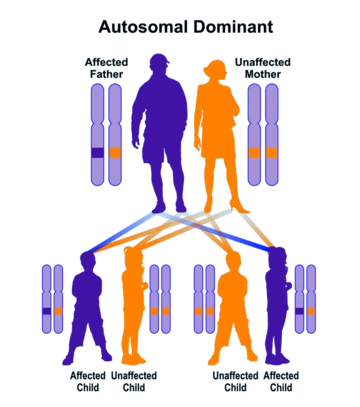
Autosomal dominant inheritance leads to a vertical pattern of transmission
Autosomal recessive
In order for autosomal recessive disorders to be expressed, offspring generally must inherit two mutations, one from each carrier parent. Carriers with only one mutation, such as the parents, do not have clinical disease. Note that carrier parents can expect that 1 in 4 children (25%) will inherit both mutations and have the disorder, 2 in 4 children (50%) will be carriers like their parents, while 1 in 4 children (25%) inherit neither mutation.

In order for autosomal recessive disorders to be expressed, offspring generally must inherit two mutations, one from each carrier parent. Carriers with only one mutation, such as the parents, do not have clinical disease. Note that carrier parents can expect that 1 in 4 children (25%) will inherit both mutations and have the disorder, 2 in 4 children (50%) will be carriers like their parents, while 1 in 4 children (25%) inherit neither mutation.