


KID Syndrome
Patient Information
Characteristics
Background and History
Skin disease, eye disease and deafness are the hallmarks of this rare inherited disorder. The KID acronym is based on the three major manifestations: Keratitis, Ichthyosis, and Deafness. It is uncertain whether KID syndrome is a single disorder or perhaps represents a collection of several diseases.
Clinical Correlations
The skin often has patchy areas of redness and scaling, especially pronounced in the neck, groin, and in the armpits (axillae). It is usually more diffuse at birth. Cancers of the skin, mouth and scalp have been reported. The deafness is of the neurosensory type and may be profound.
Some patients may develop severe liver disease as middle aged adults but it is uncertain if this occurs in everyone. The liver may become enlarged and scarred. Short stature and mental retardation have been reported in rare individuals.
The surface of the cornea (window of the eye) is normally covered by several layers of epithelial cells. In the KID syndrome, these are defective and may erode repeatedly causing severe pain, light sensitivity, and profuse tearing. This results in inflammation with dense scarring which eventually reduces vision.
Genetics
Inheritance
A gene mutation in single dose has been identified in several families, in which the disorder is passed directly from parent to child with a 50% probability, suggesting autosomal dominant inheritance. However, many other individuals do not have a family history of it. In still other families there is consanguinity among the parents and the pattern suggests autosomal recessive inheritance but no mutation has been found in these.
Pedigree
Autosomal dominant
Autosomal dominant disorders require only one mutation for the disease to be expressed. Since an affected parent has two chromosomes, only one of which has the mutant gene, parents can expect that half (50%) of their children will receive that one and inherit the disease. It is common for individuals that inherit the mutation, however, to not have evidence of the disease (nonpenetrance).
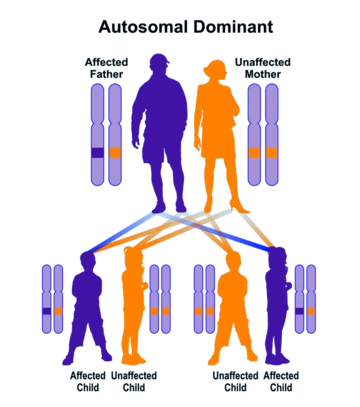
Autosomal dominant inheritance leads to a vertical pattern of transmission
Autosomal recessive
In order for autosomal recessive disorders to be expressed, offspring generally must inherit two mutations, one from each carrier parent. Carriers with only one mutation, such as the parents, do not have clinical disease. Note that carrier parents can expect that 1 in 4 children (25%) will inherit both mutations and have the disorder, 2 in 4 children (50%) will be carriers like their parents, while 1 in 4 children (25%) inherit neither mutation.

In order for autosomal recessive disorders to be expressed, offspring generally must inherit two mutations, one from each carrier parent. Carriers with only one mutation, such as the parents, do not have clinical disease. Note that carrier parents can expect that 1 in 4 children (25%) will inherit both mutations and have the disorder, 2 in 4 children (50%) will be carriers like their parents, while 1 in 4 children (25%) inherit neither mutation.
Diagnosis and Prognosis
The diagnosis is based on the physical findings and may require a dermatologist, an ophthalmologist and a pediatrician. The natural history has not been fully delineated but at least some patients live to middle age. Lifelong surveillance is necessary because of the risk of liver disease and skin cancer.
Many of the symptoms of the corneal erosions can be relieved with moisturizing eye drops. However, the scarring is not always preventable and corneal transplantation might be necessary.
Web Resources
Printer Friendly Version: Ctrl/Cmd+P