


OMIM ID:
Gabriele-de Vries Syndrome
Alternate Names
Defective Genes
Clinical Characteristics
Ocular Features
A number of nondiagnostic signs occur in the periocular structures as part of the general facial dysmorphism. There is a general fullness to the periocular area, most evident in the upper eyelids. The lid fissures slant downward and the eyebrows are sparse. Strabismus is often present. Ptosis has been noted in a few individuals.
Systemic Features
Systemic signs are inconsistent and highly variable. Intrauterine growth is usually below average. Feeding problems are evident from birth. The facial dysmorphology is highlighted by a high, broad forehead and accentuated by micrognathia and midface hypoplasia. The ears are posteriorly rotated. General development is delayed and milestones, if achieved, are delayed. Behavioral problems can be manifest as anxiety and some individuals have features of the autism spectrum. Abnormal movements such as tremor and dystonia are sometimes present.
Brain imaging may reveal delayed myelination, frontal gliosis, white matter abnormalities, and enlarged ventricles.
Genetics
Inheritance
Heterozygous mutations in the YY1 gene (14q32) have been identified in this condition. The gene is a transcription factor that acts both as a repressor and an activator in specific circumstances. Virtually all cases occur de novo.
Pedigree
Autosomal dominant
Autosomal dominant disorders require only one mutation for the disease to be expressed. Since an affected parent has two chromosomes, only one of which has the mutant gene, parents can expect that half (50%) of their children will receive that one and inherit the disease. It is common for individuals that inherit the mutation, however, to not have evidence of the disease (nonpenetrance).
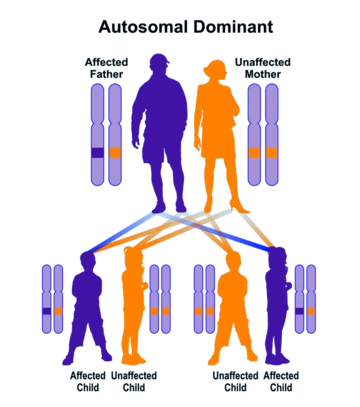
Autosomal dominant inheritance leads to a vertical pattern of transmission