


Familial Acorea, Microphthalmia and Cataract Syndrome
Defective Genes
Clinical Characteristics
Ocular Features
The pupil is obscured or absent secondary to fibrous overgrowth. Microcornea and microphthalmia are present. Iridocorneal adhesions are commonly seen on ultrasonic examination and anterior chamber angles may be narrow. The corneas are clear but thickened centrally. Nystagmus and esotropia have been reported.
The iris is rudimentary with a poorly developed stromal pattern and sometimes eccentrically located holes. The ultrasound may reveal remnants of degenerative lens capsules. Axial length in infants has been measured at about 14.7 mm but increases to 17 mm in children. In adults the axial length is about 20 mm. Refractive errors of +20-21 diopters have been measured. Visual acuity is poor from birth but can be improved to some extent following pupiloplasty and lens extraction. Intraocular pressure can be normal but one patient developed an increase in the 4th decade of life. OCT and direct visualization of the fundus in several cases revealed normal retinal architecture and anatomy.
Systemic Features
None reported. Specialty examinations failed to find any hearing loss or neurological deficits.
Genetics
Inheritance
The single 4 generation family tree reported is consistent with autosomal dominant inheritance. Several likely loci on chromosomes 1, 5, 8, 11, and 17 have been reported but no candidate gene has been identified.
Other conditions in which small pupils are found are Pierson syndrome (609049) and Warburg micro syndrome (600118) but these are associated with significant systemic abnormalities.
Congenital microcoria (156600) is an autosomal dominant disorder with mild axial myopia and goniodysgenesis resulting from an unidentified mutation on chromosome 13. Glaucoma is a common finding as is some iris hypoplasia. Despite some clinical similarities, this is likely a unique disorder.
Pedigree
Autosomal dominant
Autosomal dominant disorders require only one mutation for the disease to be expressed. Since an affected parent has two chromosomes, only one of which has the mutant gene, parents can expect that half (50%) of their children will receive that one and inherit the disease. It is common for individuals that inherit the mutation, however, to not have evidence of the disease (nonpenetrance).
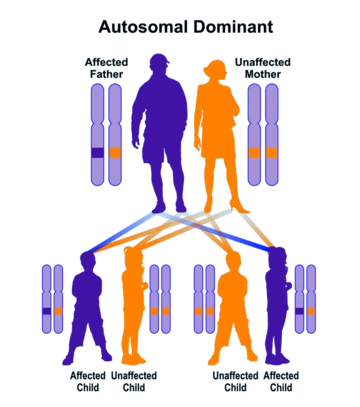
Autosomal dominant inheritance leads to a vertical pattern of transmission