


Familial Acorea, Microphthalmia and Cataract Syndrome
Patient Information
Characteristics
Background and History
This is a rare hereditary condition so far reported in only one family.
Clinical Correlations
The eye is small (microphthalmia) as is the cornea (microcornea) and the pupil (opening in the colored part of the eye) is usually absent or obscured by scar tissue (acorea). Cataracts are present at birth. Often there are other anomalies in the anterior part of the eye such as adhesions between the iris and cornea. Sometimes the iris has false openings. One young adult had glaucoma but this was not documented in other patients. The retina seems to be normal.
No systemic disease is present in other parts of the body. Specifically there is no hearing loss or neurological deficit.
Genetics
Inheritance
The family tree in the single reported family is consistent with autosomal dominant inheritance. No gene mutation has been found.
Pedigree
Autosomal dominant
Autosomal dominant disorders require only one mutation for the disease to be expressed. Since an affected parent has two chromosomes, only one of which has the mutant gene, parents can expect that half (50%) of their children will receive that one and inherit the disease. It is common for individuals that inherit the mutation, however, to not have evidence of the disease (nonpenetrance).
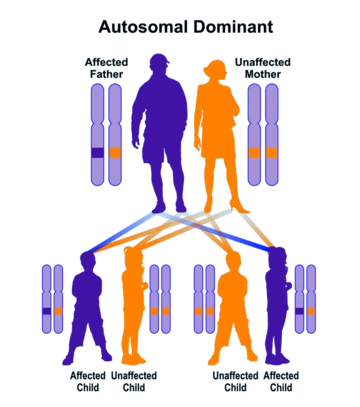
Autosomal dominant inheritance leads to a vertical pattern of transmission
Diagnosis and Prognosis
Vision is poor from birth. It can be improved by removing the cataracts and surgically reconstructing the pupil. Glasses should be prescribed. Lifelong monitoring is required to detect the onset of glaucoma which must be treated to prevent blindness.
Printer Friendly Version: Ctrl/Cmd+P