


OMIM ID:
Microcoria, Congenital
Alternate Names
Defective Genes
Clinical Characteristics
Ocular Features
This disorder is a type of anterior chamber dysgenesis since the pupil and iris anomalies are associated with goniodysgenesis (prominent iris processes and high iris root insertion) and glaucoma. The dilator muscle of the iris is hypoplastic and even topical mydriatics have little impact on pupil size. The pupil has a mean diameter of 0.8 mm and only dilates to a mean size of 1.4 mm. The iris stroma is also hypoplastic and often lacks crypts and collarettes. Transillumination defects of the iris are consistently present. Axial myopia is a feature in some families (83% of affected individuals have refractive errors in the range of -10D) and seems to be progressive . Juvenile glaucoma is frequently present (at least 30% require treatment) and is usually detected in the second (20%) through fourth decades of life. All patients with glaucoma have evidence of 'trabeculodysgenesis' but the same features may also be seen in some patients without glaucoma. The intraocular pressure is difficult to control pharmacologically. Visual acuity varies widely but no retinal changes have been described.
Ultrastructural studies show lack of myofilaments and desmin in the stromal cytoplasmic processes of the anterior pigmented cells of the iris suggesting failure of full development of the pupil dilator muscle cells.
Systemic Features
There are no systemic abnormalities in this condition.
Genetics
Inheritance
This is an autosomal dominant disorder secondary to a mutation located at 13q13-q32. The specific mutation responsible has not been identified but a large deletion at 13q32.1 in one patient has been reported.
Congenital microcoria is also a feature of autosomal recessive Pierson syndrome (609049) caused by homozygous mutations in the LAMB2 gene.
Pedigree
Autosomal dominant
Autosomal dominant disorders require only one mutation for the disease to be expressed. Since an affected parent has two chromosomes, only one of which has the mutant gene, parents can expect that half (50%) of their children will receive that one and inherit the disease. It is common for individuals that inherit the mutation, however, to not have evidence of the disease (nonpenetrance).
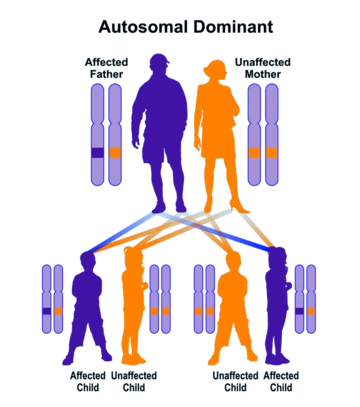
Autosomal dominant inheritance leads to a vertical pattern of transmission