


Clinical Characteristics
Ocular Features
Poor visual acuity described as central in origin with poor eye contact. Periorbital anomalies of low-set eyebrows and epicanthal folds are common. The eyes have been described as “almond-shaped”. Strabismus and nystagmus are commonly present.
Systemic Features
The facial features ae described as “fine” with a short nose and a thin upper lip. The forehead is unusually high.
There is general developmental delay with impaired intellectual development, delayed or absent walking, and behavioral psychiatric manifestations such as stereotypic and unpredictable outbursts. There are often involuntary and hyperkinetic movements with dystonia, dyskinesia, ataxia and choreoathetosis. The EEG is often abnormal although seizures have not been reported.
Genetics
Inheritance
De novo heterozygous mutations in the SYT1 gene (12q21.2) have been associated with this condition.
Pedigree
Autosomal dominant
Autosomal dominant disorders require only one mutation for the disease to be expressed. Since an affected parent has two chromosomes, only one of which has the mutant gene, parents can expect that half (50%) of their children will receive that one and inherit the disease. It is common for individuals that inherit the mutation, however, to not have evidence of the disease (nonpenetrance).
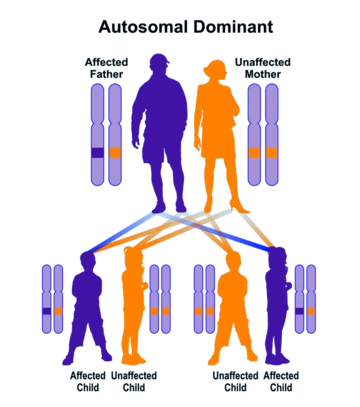
Autosomal dominant inheritance leads to a vertical pattern of transmission