


Axenfeld-Rieger Syndrome, Type 4
Alternate Names
Defective Genes
Clinical Characteristics
Ocular Features
The ocular features of this syndrome are similar to types 1-3 and primarily involve the anterior segment. The iris stroma is hypoplastic and the pupil location may be eccentric. Full thickness defects in the iris can lead to pseudopolycoria. There may be anterior displacement of the angle structures with posterior embryotoxon and localized corneal opacification. Glaucoma is a common feature and it may be present in early childhood, associated with tearing, a hazy cornea, and buphthalmos. Vitreous condensation was noted in all 4 reported individuals.
Systemic Features
The midface is flat due to maxillary underdevelopment and the teeth may be abnormally small. Micrognathia has been reported while the nasal root is abnormally broad. The umbilical defect consists of redundant skin that failed to involute normally. Congenital hip anomalies of undetermined nature and a hearing defect were reported in 2 of 4 individuals.
Genetics
Inheritance
Heterozygous mutations in the PRDM5 gene (4q25-q26) are responsible for this condition. Mutations in CYP1b1, PITX2, and FOXC1 were not present. One extended pedigree with 4 affected individuals from Pakistan has been reported.
Type 1 Axenfeld-Rieger syndrome (180500) results from heterozygous mutations in PITX2, RIEG2 (601499) from heterozygous mutations in 13q14, and RIEG3 (602482) from heterozygous mutations in the FOXC1 gene. Thus in three types of Axenfeld-Rieger syndrome (1,3, and 4) the responsible mutation occurs in a transcription factor gene which may explain why the phenotype is highly variable with considerable overlap in clinical signs.
Autosomal recessive brittle cornea syndrome type 2 (614170) is also caused by mutations in the PRDM5 gene.
Pedigree
Autosomal dominant
Autosomal dominant disorders require only one mutation for the disease to be expressed. Since an affected parent has two chromosomes, only one of which has the mutant gene, parents can expect that half (50%) of their children will receive that one and inherit the disease. It is common for individuals that inherit the mutation, however, to not have evidence of the disease (nonpenetrance).
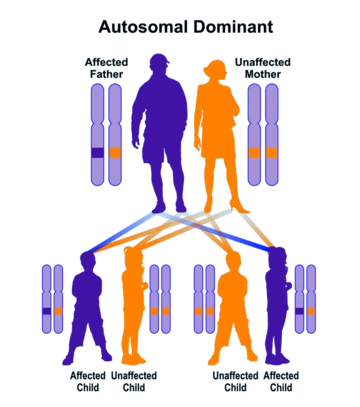
Autosomal dominant inheritance leads to a vertical pattern of transmission