


OMIM ID:
Axenfeld-Rieger Syndrome, Type 3
Alternate Names
Defective Genes
Clinical Characteristics
Ocular Features
The most important ocular feature is glaucoma, found in greater than 50% of patients. It is frequently difficult to control and blindness is far too common. The ocular phenotype has many similar features found in type 1 (RIEG1) but is discussed separately in this database since it is caused by a different mutation (see Axenfeld-Rieger syndrome, type 1 for a full description of the phenotype). It has the typical findings of anterior segment dysgenesis including anterior displacement of Schwalbe’s line, iris stromal hypoplasia, correctopia, and, of course, glaucoma.
Systemic Features
Genetics
Inheritance
This is an autosomal dominant disorder resulting from a mutation in the FOXC1, a transcription factor gene located at 6p25. Mutations in the same gene also cause iris hypoplasia/iridogoniodysgenesis (IGDA) (IRID1) 601631) which is sometimes reported as a unique disorder but is either allelic or the same disorder as the type of Axenfeld-Rieger syndrome discussed here.
Type 1 Axenfeld-Rieger syndrome (180500) results from mutations in the PITX1 transcription factor gene and type 4 from mutations in PRDM5, also a transcription factor gene. However, digenic cases have also been reported with mutations in both PITX1 and FOXC1 genes.
The mutation responsible for type 2 Axenfeld-Rieger syndrome (601499) has as yet not been identified. Diagnosis is best made by ruling out mutations in PITX1 and FOXC1 although it is claimed that maxillary hypoplasia and umbilical defects are less common in type 2.
Pedigree
Autosomal dominant
Autosomal dominant disorders require only one mutation for the disease to be expressed. Since an affected parent has two chromosomes, only one of which has the mutant gene, parents can expect that half (50%) of their children will receive that one and inherit the disease. It is common for individuals that inherit the mutation, however, to not have evidence of the disease (nonpenetrance).
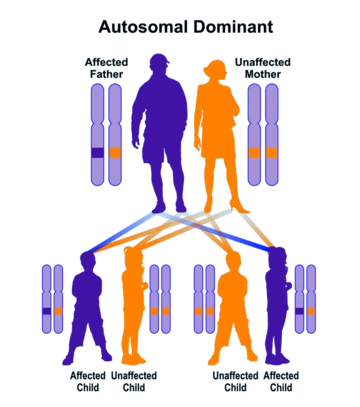
Autosomal dominant inheritance leads to a vertical pattern of transmission