


OMIM ID:
Axenfeld-Rieger Syndrome, Type 2
Alternate Names
Defective Genes
Clinical Characteristics
Ocular Features
As in RIEG1 and RIEG3, glaucoma is the most serious ocular problem. In a large family with 11 affected members, 9 had glaucoma. All had the classic ocular signs of anterior segment dysgenesis, primarily posterior embryotoxon and iris adhesions (for a full description of the ocular features see Axenfeld-Rieger syndrome, RIEG1 [180500]).
Systemic Features
Oligodontia, microdontia, and premature loss of teeth are common in type 2. Maxillary hypoplasia is less common as is hearing loss. Umbilical anomalies were not present in any affected individuals. Cardiac defects are rare.
Genetics
Inheritance
This is an autosomal dominant disorder as in the other types. The locus is at 13q14 but no molecular defect has been defined. At least two individuals purported to have type 2 were found to have deletions of this segment of chromosome 13.
Pedigree
Autosomal dominant
Autosomal dominant disorders require only one mutation for the disease to be expressed. Since an affected parent has two chromosomes, only one of which has the mutant gene, parents can expect that half (50%) of their children will receive that one and inherit the disease. It is common for individuals that inherit the mutation, however, to not have evidence of the disease (nonpenetrance).
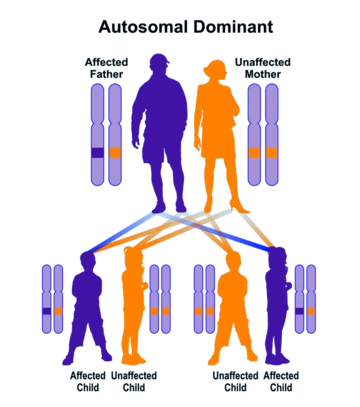
Autosomal dominant inheritance leads to a vertical pattern of transmission