


OMIM ID:
ZTTK Syndrome
Alternate Names
Defective Genes
Clinical Characteristics
Ocular Features
The eyes are deep-set and the palpebral fissures slant downward. Optic atrophy is often present. The majority of individuals have poor visual responses which may also be attributed to central or cortical impairment. Strabismus and nystagmus are frequently present.
Systemic Features
ZTTK syndrome is multisystem malformation and developmental disorder with a heterogeneous clinical presentation. The facial features might suggest the diagnosis at birth but most of the signs are nonspecific including frontal bossing, underdevelopment of the midface, facial asymmetry, low-set ears, broad and/or depressed nasal bridge, and a short philtrum. Poor feeding and hypotonia in the neonatal period are usually present and physical growth is subnormal resulting in short stature.
Brain imaging may show abnormal gyral patterns, ventriculomegaly, hypoplasia of the corpus callosum, cerebellar hypoplasia, arachnoid cysts, and loss of periventricular white matter. About half of patients develop seizures and many have intellectual disabilities. Spinal anomalies include hemivertebrae with scoliosis and/or kyphosis. Other skeletal features include joint laxity in some patients and contractures in others. Arachnodactyly, craniosynostosis, and rib anomalies have been reported. There may be malformations in the GI, GU, and cardiac systems while immune and coagulation abnormalities have also been reported.
Genetics
Inheritance
Heterozygous mutations in the SON gene (21q22.11) have been identified in patients with this condition. They may cause truncation of the gene product with haploinsufficiency or, in other patients, a frameshift in the reading. The SON gene is a master RNA splicing regulator that impacts neurodevelopment.
Virtually all cases are the result of de novo mutations.
Pedigree
Autosomal dominant
Autosomal dominant disorders require only one mutation for the disease to be expressed. Since an affected parent has two chromosomes, only one of which has the mutant gene, parents can expect that half (50%) of their children will receive that one and inherit the disease. It is common for individuals that inherit the mutation, however, to not have evidence of the disease (nonpenetrance).
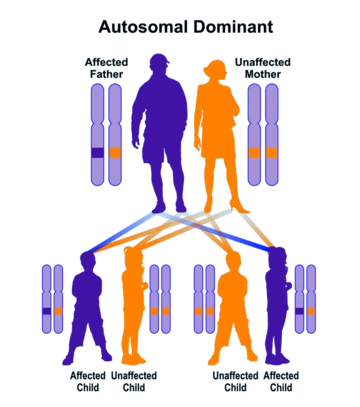
Autosomal dominant inheritance leads to a vertical pattern of transmission