


ZTTK Syndrome
Patient Information
Characteristics
Background and History
This recently described heritable disorder consists of multiple deformities and intellectual deficits.
Clinical Correlations
The facial variations may be recognizable at birth. The ears are low-set, there is frontal bossing, the mid-face is depressed, the eyebrows are horizontal, and the opening between the eyelids slant downward. The eyes appear deep-set and the lips are thin. Infants feed poorly, they may have difficulty breathing, and seem ‘floppy’. Developmental delay and even regression are common. Seizures often develop between the ages of 1 and 6 years. Short stature is common. Vision is subnormal in many patients and there may be strabismus (crossing of the eyes), and nystagmus (jerky movements of the eyes).
Imaging of the brain reveals a variety of abnormalities primarily consisting of incompletely developed brain tissue. Other skeletal deformities include those of the vertebrae, cleft palate, and abnormal closure of skull sutures. The heart, the intestinal tract, and the urinary system may also have anomalies.
Genetics
Inheritance
This is an autosomal dominant disorder in which a mutation in a specific gene is responsible. Children of a parent with this mutation have a 50% risk of inheriting the mutation. However, in most individuals the mutation occurs de novo and is not inherited.
Pedigree
Autosomal dominant
Autosomal dominant disorders require only one mutation for the disease to be expressed. Since an affected parent has two chromosomes, only one of which has the mutant gene, parents can expect that half (50%) of their children will receive that one and inherit the disease. It is common for individuals that inherit the mutation, however, to not have evidence of the disease (nonpenetrance).
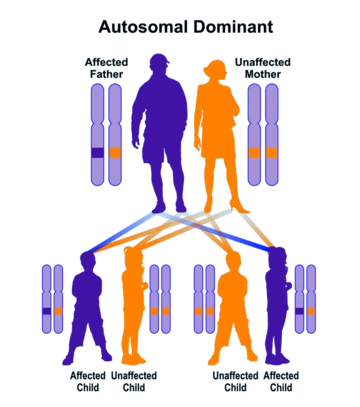
Autosomal dominant inheritance leads to a vertical pattern of transmission
Diagnosis and Prognosis
The diagnosis may be made at birth but most of the physical signs are mild and nondiagnostic. Multiple specialists would likely collaborate on diagnosis and care. There is no treatment for the general condition but addressing individual problems of various organ systems may be helpful. Physical therapy should be considered.
Web Resources
Printer Friendly Version: Ctrl/Cmd+P