


OMIM ID:
Myotonic Dystrophy 2
Alternate Names
Defective Genes
Clinical Characteristics
Ocular Features
Polychromatic lens opacities and posterior subcapsular sclerosis are found in 15-30% of patients.
Ptosis, ophthalmoplegia and strabismus are not features of DM2.As many as 25% of patients with DM have a pigmentary retinopathy, usually in a butterfly pattern.
Systemic Features
Symptoms of myotonia usually appear in the third and fourth decades of life while evidence of limb girdle muscle weakness usually appears much later. There is no infancy or childhood form of the disease and developmental delays do not occur. In some patients the proximal muscles seem to be more affected than distal muscles and such cases are sometimes referred to as PROMM disease. In these patients the neck and finger flexors may be the first to be affected. However, there is considerable clinical variability. Facial weakness is minimal. Eventually both proximal and distal muscles weaken. Myalgia of a burning, tearing nature can be debilitating. Cardiac arrhythmias occur in a minority of patients. Frontal balding is characteristic. The long-term prognosis is better than in patients with myotonic dystrophy 1 (160900), and some but not all reports suggest fewer individuals experience age-related cognitive decline. Insulin insensitivity and testicular failure occur in approximately half of patients.
PROMM disease and DM2 are now generally accepted as the same disease and the latter designation is preferred.
Genetics
Inheritance
Like classic myotonic dystrophy 1 (160900), this disorder also results from an abnormal number of repeats (in this case of CCTG). Up to 30 tetranucleotide repeats in CNBP (3q21.3) is normal but patients with myotonic dystrophy 2 may have 11,000 or more and the number increases with age. The repeat length may diminish with generational transmission. Unlike DM 1, the repeat number does not seem to correlate with disease severity. Both DM1 and DM2 are inherited in an autosomal dominant pattern.
Pedigree
Autosomal dominant
Autosomal dominant disorders require only one mutation for the disease to be expressed. Since an affected parent has two chromosomes, only one of which has the mutant gene, parents can expect that half (50%) of their children will receive that one and inherit the disease. It is common for individuals that inherit the mutation, however, to not have evidence of the disease (nonpenetrance).
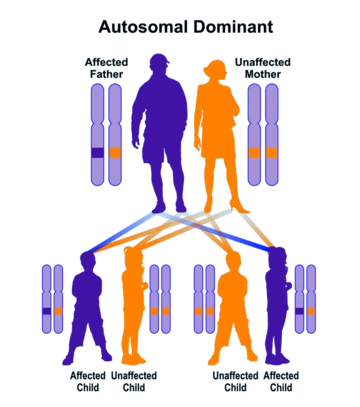
Autosomal dominant inheritance leads to a vertical pattern of transmission