


Osteogenesis Imperfecta
Patient Information
Characteristics
Background and History
The term osteogenesis imperfecta (OI) is used for a group of disorders in which genetic defects result in abnormally brittle bones that fracture easily. A number of types have been described based on the severeity of disease. This group of disorders is also known as ‘brittle bone disease’.
Clinical Correlations
In the most severe type of OI bones are often broken in utero. Infants with this type are also born with an abnormal rib cage and underdeveloped lungs and often die in infancy. Other infants with less severe disease are mainly susceptible to bone fractures during childhood and adolescence and have less risk for broken bones as adults. The trauma leading to fractures is usually minimal in nature and, if treated promptly, the fractures will heal without serious sequelae. Other associated features include, in some patients, short stature, easy bruising, and imperfectly formed teeth. A progressive hearing loss, usually sensorineural in type, occurs in 40% of adults with this disease. In the majority of patients, the normally white sclerae of the eye is blue which may eventually disappear or at least fade.
Genetics
Inheritance
Osteogenesis imperfecta is inherited in an autosomal dominant or vertical pattern. The disorder requires only a single mutation for expression and is therefore passed directly from parent to child. Many cases occur without a prior family history, however.
Pedigree
Autosomal dominant
Autosomal dominant disorders require only one mutation for the disease to be expressed. Since an affected parent has two chromosomes, only one of which has the mutant gene, parents can expect that half (50%) of their children will receive that one and inherit the disease. It is common for individuals that inherit the mutation, however, to not have evidence of the disease (nonpenetrance).
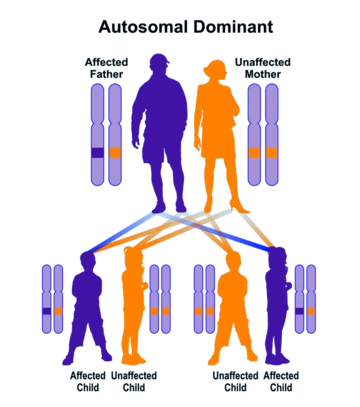
Autosomal dominant inheritance leads to a vertical pattern of transmission
Diagnosis and Prognosis
Blue sclerae is not a particularly useful diagnostic sign since it can be found to some degree in individuals, especially infants, without OI. Often the diagnosis is not made until relatively minor trauma results in a broken bone. Among individuals with the more severe form of the disease, ribs and long bones of the arms and legs may break even with gentle lifting or turning of an infant. Pediatricians and orthopedists often make the diagnosis but a multidisciplinary team is important to parents and individuals for both everyday care and in rehabilitation.
Avoidance of any kind of trauma is important. Broken bones need to be treated promptly and appropriately to enhance healing and avoid later deformities. The prognosis depends largely on the severity of the underlying disease. Periodic intravenous administration of a drug known as pamidronate has been shown in at least some patients to increase bone density and decrease the risk of fractures.
Web Resources
Printer Friendly Version: Ctrl/Cmd+P