


Night Blindness, Congenital Stationary, CSNBAD2
Patient Information
Characteristics
Background and History
Various conditions causing poor night vision, sometimes called night blindness, have been known for centuries. Many disorders of the retina cause night blindness and most of these are progressive and associated with other ocular disease. However, several conditions causing difficulties with night vision are not progressive nor are they part of other syndromes. These are generally referred to as congenital stationary night blindness (CSNB).
Clinical Correlations
Difficulty seeing at night is the primary symptom of congenital stationary night blindness. The condition is present at birth and does not progress. Daytime vision may be reduced to some degree as well. Mild color vision defects can sometimes be detected.
In this disease (CSNBAD2) the daytime vision is normal and but night vision is reduced in dim conditions. It is better with bright backgrounds. Color vision is normal. Both sexes are affected.
Genetics
Inheritance
Mutations in at least 8 different genes are known to cause CSNB. This type (CSNBAD2) is inherited in an autosomal dominant pattern in which the single mutated gene (and disease) is passed directly from parent to child with a 50% probability.
Pedigree
Autosomal dominant
Autosomal dominant disorders require only one mutation for the disease to be expressed. Since an affected parent has two chromosomes, only one of which has the mutant gene, parents can expect that half (50%) of their children will receive that one and inherit the disease. It is common for individuals that inherit the mutation, however, to not have evidence of the disease (nonpenetrance).
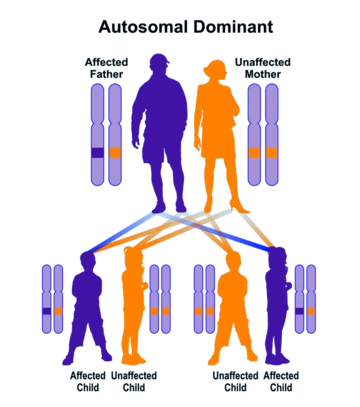
Autosomal dominant inheritance leads to a vertical pattern of transmission
Diagnosis and Prognosis
Diagnosis is based on an ophthalmological examination. An electroretinogram (ERG) test is important to establish the diagnosis and to rule out other retinal disease. This is a stationary disease without significant progression and no systemic disease is present.
The only treatment is correction of refractive errors if needed.
Web Resources
Printer Friendly Version: Ctrl/Cmd+P