


OMIM ID:
Night Blindness, Congenital Stationary, CSNBAD2
Alternate Names
Defective Genes
Clinical Characteristics
Ocular Features
Night blindness is a feature of many pigmentary and other retinal disorders, most of which are progressive. However, there is also a group of genetically heterogeneous disorders, with generally stable scotopic defects and without RPE changes, known as congenital stationary night blindness (CSNB). At least 10 mutant genes are responsible with phenotypes so similar that genotyping is usually necessary to distinguish them. All are caused by defects in visual signal transduction within rod photoreceptors or in defective photoreceptor-to-bipolar cell signaling with common ERG findings of reduced or absent b-waves and generally normal a-waves. However, the photopic ERG can be abnormal to some degree as well and visual acuity may be subnormal. In the pregenomic era, subtleties of ERG responses were frequently used in an attempt to distinguish different forms of CSNB. Genotyping now enables classification with unprecedented precision.
Congenital stationary night blindness disorders are primarily rod dystrophies presenting early with symptoms of nightblindness and relative sparing of central vision. Nystagmus and photophobia are usually not features. Dyschromatopsia and loss of central acuity can develop later as the cones eventually become dysfunctional as well but these symptoms are much less severe than those seen in cone-rod dystrophies. The amount of pigmentary retinopathy is highly variable.
This disorder (CSNBAD2) is one of three autosomal dominant CSNB conditions. ERG responses were identical to those found in the Nougaret type of autosomal dominant CSNB. Rod a-wave responses to single flashes are completely absent suggesting complete lack of rod function. The residual b-wave suggests some cone response. Daytime and color vision are normal.
Systemic Features
No systemic disease is associated with congenital stationary night blindness.
Genetics
Inheritance
CSNBAD2, or type AD2, is one of three congenital nightblindness disorders with autosomal dominant inheritance. It results from mutations in the PDE6B gene (4p16.3) encoding a subunit of rod cGMP-specific phosphodiesterase.
Other CSNB disorders inherited in an autosomal dominant pattern are CSNBAD1 (610445) and CSNBAD3 (610444).
Three CSNB disorders are transmitted in an autosomal recessive pattern and two as X-linked recessives.
Pedigree
Autosomal dominant
Autosomal dominant disorders require only one mutation for the disease to be expressed. Since an affected parent has two chromosomes, only one of which has the mutant gene, parents can expect that half (50%) of their children will receive that one and inherit the disease. It is common for individuals that inherit the mutation, however, to not have evidence of the disease (nonpenetrance).
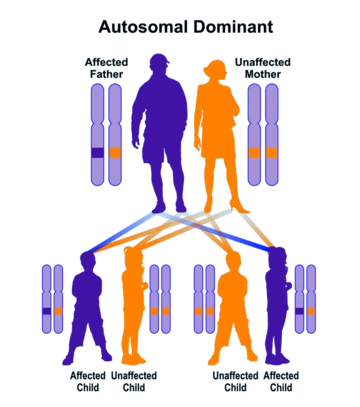
Autosomal dominant inheritance leads to a vertical pattern of transmission