


Nanophthalmos 3
Patient Information
Characteristics
Background and History
Nanophthalmos, or small eye, is a disorder limited to the eye in which it is significantly smaller than normal. It has long been known to be one of several conditions that carry a risk for a rare type of glaucoma known as angle closure glaucoma. The term microphthalmos is sometimes applied to small eyes as well but generally refers to a different condition in which there are other associated abnormalities.
Clinical Correlations
This type of inherited nanophthalmos has been reported in 12 members of a 6 generation Chinese family. All were farsighted because of the small short eyeballs. The eyelids appeared to droop and the clear corneas (windshield of the eye) were small. No other eye or general problems were reported.
Genetics
Inheritance
Based on the single family reported, the inheritance pattern suggests autosomal dominant inheritance. The eye problem appeared in a vertical pattern. Affected parents can expect that half of their children will inherit this form of nanophthalmos.
Pedigree
Autosomal dominant
Autosomal dominant disorders require only one mutation for the disease to be expressed. Since an affected parent has two chromosomes, only one of which has the mutant gene, parents can expect that half (50%) of their children will receive that one and inherit the disease. It is common for individuals that inherit the mutation, however, to not have evidence of the disease (nonpenetrance).
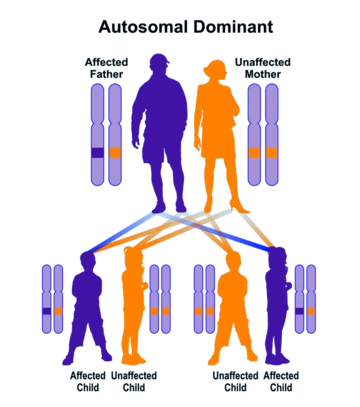
Autosomal dominant inheritance leads to a vertical pattern of transmission
Diagnosis and Prognosis
An eye doctor (ophthalmologist) would diagnose this condition. The anatomical alterations in these small eyes create a risk of acute glaucoma that requires immediate surgery. Since this is present throughout life, regular eye exams are advised. There is no impact on general health.
Printer Friendly Version: Ctrl/Cmd+P