


OMIM ID:
Nanophthalmos 3
Alternate Names
Defective Genes
Clinical Characteristics
Ocular Features
A six generation Chinese family has been reported in which 12 affected members had small eyes, ptosis, apparent enophthalmos, shallow anterior chambers, and small corneas. Hyperopic refractive errors ranged from +6.00 to +11.25 (mean +8.25).
Systemic Features
None reported.
Genetics
Inheritance
The transmission pattern for this 6 generation family strongly suggests autosomal dominant inheritance. No mutation has been identified but the 2q11-14 locus is strongly associated with the phenotype.
Pedigree
Autosomal dominant
Autosomal dominant disorders require only one mutation for the disease to be expressed. Since an affected parent has two chromosomes, only one of which has the mutant gene, parents can expect that half (50%) of their children will receive that one and inherit the disease. It is common for individuals that inherit the mutation, however, to not have evidence of the disease (nonpenetrance).
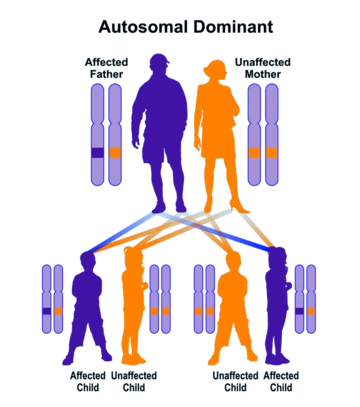
Autosomal dominant inheritance leads to a vertical pattern of transmission