


Keratitis, Hereditary
Patient Information
Characteristics
Background and History
Keratitis is the name given to inflammation of the cornea, the window in the front of the eye. It can follow trauma, infections, or be part of inherited disease as in this disorder.
Clinical Correlations
This inherited form of keratitis usually begins in the first year of life. Symptoms include sensitivity to light, excessive tearing, pain, and redness. Excessive mucous discharge is often noted. There is some cloudiness to the edge of the normally clear cornea and blood vessels may grow into this area. There is usually considerable asymmetry between the two eyes. The disease is progressive and recurrent so that eventually vision is reduced as the cloudiness progresses to involve more of the cornea. When this occurs in young children, they may develop a lazy eye (amblyopia) and crossing of the eyes.
A significant number of individuals have abnormalities of the iris (colored part of the eye that forms the pupil) and underdevelopment of the retina.
Genetics
Inheritance
Reported families have a vertical pattern of transmission known as autosomal dominant inheritance. In this pattern, affected parents can pass the disorder directly to their children and they can expect on average that half will also have the disease.
Pedigree
Autosomal dominant
Autosomal dominant disorders require only one mutation for the disease to be expressed. Since an affected parent has two chromosomes, only one of which has the mutant gene, parents can expect that half (50%) of their children will receive that one and inherit the disease. It is common for individuals that inherit the mutation, however, to not have evidence of the disease (nonpenetrance).
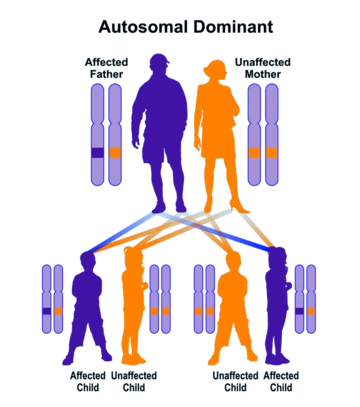
Autosomal dominant inheritance leads to a vertical pattern of transmission
Diagnosis and Prognosis
There is no disease elsewhere in the body. An ophthalmologist usually makes the diagnosis. Corneal transplantation replacing the diseased cornea with clear donor tissue is generally unsuccessful as the new tissue develops the same disease.
Web Resources
Printer Friendly Version: Ctrl/Cmd+P