


Iridogoniodysgenesis, Type 2
Patient Information
Characteristics
Background and History
In many inherited eye conditions there are developmental defects that lead to abnormal function. In this disorder the front part including the iris (colored part) and the cornea (windshield) are deformed resulting in glaucoma. A similar disorder is known as Iridogoniodysgenesis, type 2.
Clinical Correlations
This is a congenital condition which may be diagnosed at birth. The iris is abnormally dark and the cornea is malformed. Glaucoma may be present at birth but this is usually diagnosed sometime in the first decade of life. Uncontrolled, the glaucoma may result in blindness.
There are usually no abnormalities elsewhere in the body.
Genetics
Inheritance
This is an autosomal dominant condition in which the abnormal gene is passed from parent to child with a 50% probability.
Pedigree
Autosomal dominant
Autosomal dominant disorders require only one mutation for the disease to be expressed. Since an affected parent has two chromosomes, only one of which has the mutant gene, parents can expect that half (50%) of their children will receive that one and inherit the disease. It is common for individuals that inherit the mutation, however, to not have evidence of the disease (nonpenetrance).
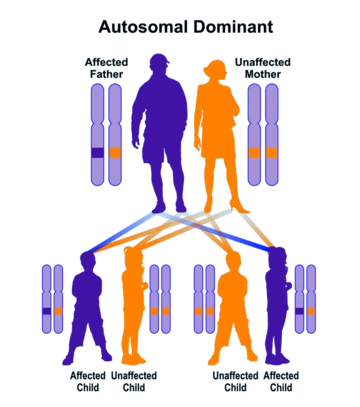
Autosomal dominant inheritance leads to a vertical pattern of transmission
Diagnosis and Prognosis
The diagnosis is generally made by an ophthalmologist. In families with this disorder, it is important that all family members are examined periodically to enable detection of glaucoma before irreversible vision damage occurs. Glaucoma may be difficult to control and vigorous management is necessary.
Web Resources
Printer Friendly Version: Ctrl/Cmd+P