


Hypoparathyroidism, Familial Isolated
Patient Information
Characteristics
Background and History
This is a hereditary endocrine disorder in which there is a lack of the normal amounts of parathyroid hormone.
Clinical Correlations
Signs and symptoms are variable and some patients have virtually no complaints. The majority of symptoms and signs are caused by low amounts of circulating calcium. This causes neuromuscular irritability with muscular spasms, especially notable in speech. Tingling about the mouth and of the fingers and toes is common. Grand mal seizures are not uncommon. Sparsity of hair, abnormal dental development, coarse brittle hair, personality changes and even mental retardation are sometimes present. Brain imaging may reveal calcium deposits in certain areas. Calcium levels are low and phosphorus levels are high in the serum.
Genetics
Inheritance
Many cases are sporadic but others occur in an autosomal recessive or autosomal dominant inheritance pattern suggesting that there is residual genetic heterogeneity. Changes (mutations) in several genes have been found in some individuals and the risks of hypoparathyroidism among offspring have to be determined based on gene studies for each family.
Pedigree
Autosomal dominant
Autosomal dominant disorders require only one mutation for the disease to be expressed. Since an affected parent has two chromosomes, only one of which has the mutant gene, parents can expect that half (50%) of their children will receive that one and inherit the disease. It is common for individuals that inherit the mutation, however, to not have evidence of the disease (nonpenetrance).
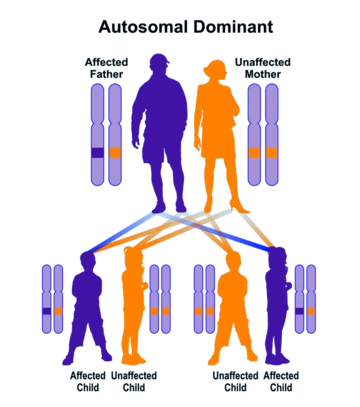
Autosomal dominant inheritance leads to a vertical pattern of transmission
Autosomal recessive
In order for autosomal recessive disorders to be expressed, offspring generally must inherit two mutations, one from each carrier parent. Carriers with only one mutation, such as the parents, do not have clinical disease. Note that carrier parents can expect that 1 in 4 children (25%) will inherit both mutations and have the disorder, 2 in 4 children (50%) will be carriers like their parents, while 1 in 4 children (25%) inherit neither mutation.

In order for autosomal recessive disorders to be expressed, offspring generally must inherit two mutations, one from each carrier parent. Carriers with only one mutation, such as the parents, do not have clinical disease. Note that carrier parents can expect that 1 in 4 children (25%) will inherit both mutations and have the disorder, 2 in 4 children (50%) will be carriers like their parents, while 1 in 4 children (25%) inherit neither mutation.
Diagnosis and Prognosis
Due to the variability in clinical disease, the diagnosis may not be evident and only studies of the blood calcium suggest the presence of hypoparathyroidism. In others the neuromuscular signs lead to further investigations that reveal the diagnosis. Treatment consists of normalizing the calcium and phosphorous levels. Studies of vitamin D levels should be done and correction of deficiencies can be helpful. Some individuals may require cataract surgery to restore vision. Seizures require treatment but they may be reduced with restoration of normal calcium levels.
Web Resources
Printer Friendly Version: Ctrl/Cmd+P