


OMIM ID:
Hypoparathyroidism, Familial Isolated
Alternate Names
Defective Genes
Clinical Characteristics
Ocular Features
Lens opacities may be present.
Systemic Features
The major signs and symptoms result from hypocalcemia. Neuromuscular irritability and various paresthesias may be present. Some patients have laryngeal spasm and latent tetany with grand mal seizures. Alopecia, abnormal dentition and coarse brittle hair may be present. Cognitive deficits and personality disorders are often a feature. Brain imaging may show calcification of the basal ganglia. Serum calcium levels are usually low while phosphorus levels are elevated. Vitamin D precursor levels are usually low or low normal.
Genetics
Inheritance
Familial hypoparathyroidism may be due to mutations in the PTH gene (11p15.3) (either autosomal dominant or recessive inheritance) or in the GCMB gene (6p24.2) (autosomal dominant inheritance pattern).
There is also an X-linked form of hypoparathyroidism (307700) in which parathryroid tissue may be congenitally absent.
A family has been reported in which hypoparathryroidism was associated with lymphedema (247410) and progressive renal failure. Ptosis, telecanthus, hypertrichosis, restrictive lung disease, and mitral valve prolapse may also be part of the disorder.
Pedigree
Autosomal dominant
Autosomal dominant disorders require only one mutation for the disease to be expressed. Since an affected parent has two chromosomes, only one of which has the mutant gene, parents can expect that half (50%) of their children will receive that one and inherit the disease. It is common for individuals that inherit the mutation, however, to not have evidence of the disease (nonpenetrance).
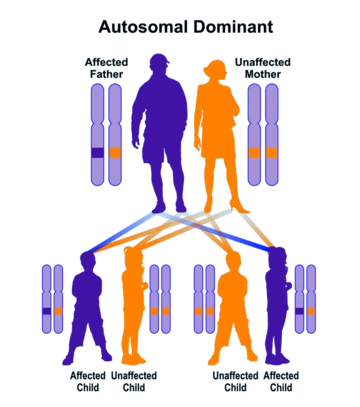
Autosomal dominant inheritance leads to a vertical pattern of transmission
Autosomal recessive
In order for autosomal recessive disorders to be expressed, offspring generally must inherit two mutations, one from each carrier parent. Carriers with only one mutation, such as the parents, do not have clinical disease. Note that carrier parents can expect that 1 in 4 children (25%) will inherit both mutations and have the disorder, 2 in 4 children (50%) will be carriers like their parents, while 1 in 4 children (25%) inherit neither mutation.

In order for autosomal recessive disorders to be expressed, offspring generally must inherit two mutations, one from each carrier parent. Carriers with only one mutation, such as the parents, do not have clinical disease. Note that carrier parents can expect that 1 in 4 children (25%) will inherit both mutations and have the disorder, 2 in 4 children (50%) will be carriers like their parents, while 1 in 4 children (25%) inherit neither mutation.