


Histiocytic Dermatoarthritis
Patient Information
Characteristics
Background and History
This disorder has only been reported in one family
Clinical Correlations
Four members, a father and three children, had glaucoma, intraocular inflammation, and cataracts. Non-tender, brownish lumps appeared in the skin between the ages of 4 and 15 years together with painful joints that led to severe deformations in the hands, feet and elbows. The skin lesions were found primarily in the hands, ear lobes, and the arms. In addition the skin in the legs became thickened.
Genetics
Inheritance
The family pattern suggests autosomal dominant inheritance but no mutation has been identified.
Pedigree
Autosomal dominant
Autosomal dominant disorders require only one mutation for the disease to be expressed. Since an affected parent has two chromosomes, only one of which has the mutant gene, parents can expect that half (50%) of their children will receive that one and inherit the disease. It is common for individuals that inherit the mutation, however, to not have evidence of the disease (nonpenetrance).
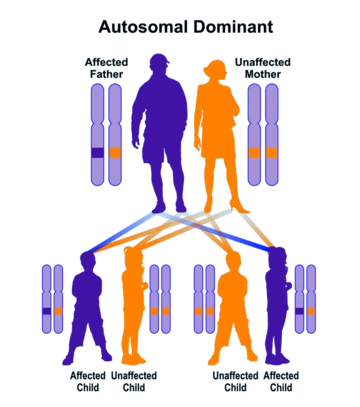
Autosomal dominant inheritance leads to a vertical pattern of transmission
Diagnosis and Prognosis
The diagnosis is made by the combination of the skin, joint and eye findings. Dermatologists and ophthalmologists together could make the diagnosis. The glaucoma should be treated by an ophthalmologist and orthopedic surgery can correct the joint deformities.
Printer Friendly Version: Ctrl/Cmd+P