


Ectopia lentis, Isolated AD
Patient Information
Characteristics
Background and History
The lens in the eye focuses images onto the retina. However, it may be displaced from its normal position in which case it is called ectopia lentis, or simply a dislocated lens. It may follow trauma or internal eye infections but it may also occur as an isolated condition secondary to gene mutations.
Clinical Correlations
In this rare condition, the lens is often displaced from birth but this may be missed until loss of vision is evident. Vision is often normal but is highly variable depending upon the amount of lens dislocation. In isolated (without systemically associated abnormalities) ectopia lentis, there is generally no other disease of the eye such as glaucoma, clouding of the cornea, or retinal detachments. Amblyopia or ‘lazy eye’ may, however, occur in which case crossing of the eyes or nystagmus (dancing of the eyes) may be present.
Genetics
Inheritance
This is an autosomal dominant condition in which the condition is passed directly from parent to child. Affected parents can expect that on average one that half of their children will have dislocated lenses.
Pedigree
Autosomal dominant
Autosomal dominant disorders require only one mutation for the disease to be expressed. Since an affected parent has two chromosomes, only one of which has the mutant gene, parents can expect that half (50%) of their children will receive that one and inherit the disease. It is common for individuals that inherit the mutation, however, to not have evidence of the disease (nonpenetrance).
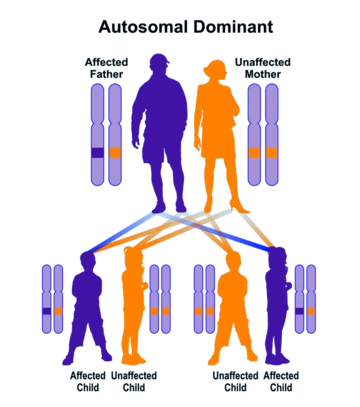
Autosomal dominant inheritance leads to a vertical pattern of transmission
Diagnosis and Prognosis
The diagnosis is made from a complete eye examination. It should be made early, preferably in infancy, since the obstruction to good vision can cause a ‘lazy eye’ or amblyopia. The dislocated lens may be surgically removed but this should be considered only when vision cannot be corrected with glasses or contact lenses. Only a few families have been reported and in most there is no systemic abnormalities have been noted. The prognosis for a normal life is excellent. However, it is well known that dislocated lenses are often associated with increased risk of glaucoma and retinal detachments and it is suggested that patients with this condition should have periodic evaluations throughout their lives. The prognosis for a normal life is excellent.
Web Resources
Printer Friendly Version: Ctrl/Cmd+P