


Cataracts, Anterior Polar 2
Patient Information
Characteristics
Background and History
Cataracts are opacifications of the lens in the eye. There are multiple types and may be caused by a number of mechanisms including trauma, infections, metabolic errors, and gene mutations. This is one of a number of congenital cataracts located at the front (anterior) surface.
Clinical Correlations
This type of cataract is present at birth and usually does not progress. The opacity is located at the very front (anterior) of the lens in the form of a dot or small plaque. There is usually little if any interference with vision. No systemic abnormalities have been found.
Genetics
Inheritance
Most anterior polar cataracts occur sporadically. In the few families reported, the pattern of transmission is parent-to-child as is characteristic of autosomal dominant disorders. The gene mutation responsible has not been identified.
Pedigree
Autosomal dominant
Autosomal dominant disorders require only one mutation for the disease to be expressed. Since an affected parent has two chromosomes, only one of which has the mutant gene, parents can expect that half (50%) of their children will receive that one and inherit the disease. It is common for individuals that inherit the mutation, however, to not have evidence of the disease (nonpenetrance).
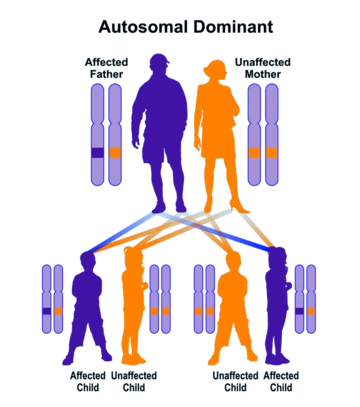
Autosomal dominant inheritance leads to a vertical pattern of transmission
Diagnosis and Prognosis
Anterior polar cataracts are usually diagnosed by ophthalmologists. The prognosis is excellent as they usually do not progress and surgery is seldom required.
Printer Friendly Version: Ctrl/Cmd+P