


OMIM ID:
Cataracts, Anterior Polar 2
Alternate Names
Defective Genes
Clinical Characteristics
Ocular Features
Lens opacities are located in the central anterior capsule and cortex. They usually do not interfere significantly with vision.
Systemic Features
None.
Genetics
Inheritance
Most cases probably occur sporadically but multigenerational families have been reported in which the transmission pattern is autosomal dominant. In one family the phenotype was mapped to 17p13 but the gene responsible has not been identified.
Another type (CTAA1) of anterior polar cataract is associated with chromosomal aberrations (115650).
Yet another form of autosomal dominant anterior polar cataract is associated with corneal disease (Cataracts, Anterior Polar with Guttata) (121390).
Other cataracts that map to chromosome 17 are zonular sutural cataract (600881) with a locus at 17q11-q12 and cerulean or ‘blue dot’ cataract (115660) at 17q24.
Pedigree
Autosomal dominant
Autosomal dominant disorders require only one mutation for the disease to be expressed. Since an affected parent has two chromosomes, only one of which has the mutant gene, parents can expect that half (50%) of their children will receive that one and inherit the disease. It is common for individuals that inherit the mutation, however, to not have evidence of the disease (nonpenetrance).
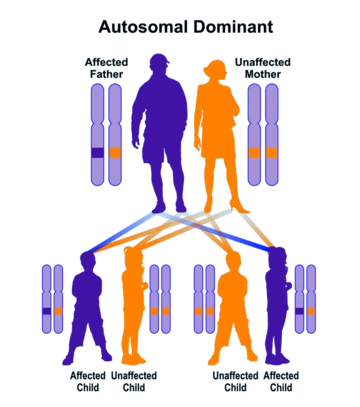
Autosomal dominant inheritance leads to a vertical pattern of transmission