


Autoinflammation with Arthritis and Dyskeratosis
Patient Information
Characteristics
Background and History
This recently reported heritable condition has its onset in childhood with recurrent fevers, arthritis, and dry skin and eyes.
Clinical Correlations
Signs and symptoms of dry skin with and bumpy excrescences are evident by 5-6 years of age. At the same time children complain of sensitivity to light because the cornea dries out for lack of normal tears. The surface of the cornea (windshield of the eye at the front) thickens and becomes irregular due to lack of wetting. Eventually new vessels (neovascularization) of the corneal surface takes place.
The growth plates of the long bones in the legs (femur and tibia) have minor malformations on X-ray and arthritis occurs primarily in the knee joints.
There are also immunological changes that contribute to the susceptibility of infections.
Genetics
Inheritance
This condition is familial but too few families have been reported to determine the pattern of transmission. A specific gene mutation has been associated with the disorder but in some families both members of the pair are changed (as in autosomal recessive inheritance) while in others a single mutation is present in one member (as in autosomal dominant inheritance).
Pedigree
Autosomal dominant
Autosomal dominant disorders require only one mutation for the disease to be expressed. Since an affected parent has two chromosomes, only one of which has the mutant gene, parents can expect that half (50%) of their children will receive that one and inherit the disease. It is common for individuals that inherit the mutation, however, to not have evidence of the disease (nonpenetrance).
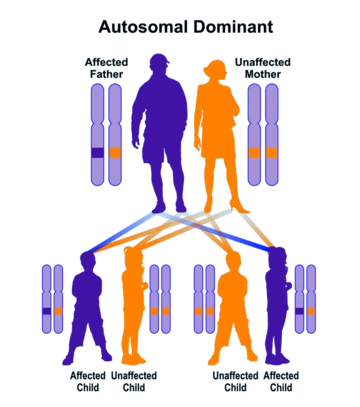
Autosomal dominant inheritance leads to a vertical pattern of transmission
Autosomal recessive
In order for autosomal recessive disorders to be expressed, offspring generally must inherit two mutations, one from each carrier parent. Carriers with only one mutation, such as the parents, do not have clinical disease. Note that carrier parents can expect that 1 in 4 children (25%) will inherit both mutations and have the disorder, 2 in 4 children (50%) will be carriers like their parents, while 1 in 4 children (25%) inherit neither mutation.

In order for autosomal recessive disorders to be expressed, offspring generally must inherit two mutations, one from each carrier parent. Carriers with only one mutation, such as the parents, do not have clinical disease. Note that carrier parents can expect that 1 in 4 children (25%) will inherit both mutations and have the disorder, 2 in 4 children (50%) will be carriers like their parents, while 1 in 4 children (25%) inherit neither mutation.
Diagnosis and Prognosis
This is a complex disorder and cannot be diagnosed without genetic testing. It is not physically evident at birth and extensive neurological, physical, radiological, endocrinological, immunological, and dermatological studies may be necessary to make the diagnosis, most likely in the first decade of life.
Nothing is known regarding longevity. There is no treatment for the overall disorder but there may be specific therapies for the arthritis, skin and eyes. The skin may benefit from moisturizing emollients that prevent excessive drying. The surface of the eye must be kept moist for which there are many lubricating drops and ointments but these must be used on a regular basis in this chronic condition.
Printer Friendly Version: Ctrl/Cmd+P