


OMIM ID:
Autoinflammation with Arthritis and Dyskeratosis
Alternate Names
Defective Genes
Clinical Characteristics
Ocular Features
Signs and symptoms of dry eyes are evident early in the first decade. Punctate keratitis with photophobia are present by 5 or 6 years of age followed by corneal dyskeratosis and neovascularization. One 16-year-old male was reported to have uveitis.
Systemic Features
Recurrent febrile episodes lasting 3-4 days with impaired sweating occur early in the first decade. Small hyperkeratosis may be seen on the limbs, shoulders, and flanks. Diffuse xerosis is evident throughout. Keratotic lesions occur on the soles as well. Arthritis in the lower limbs occurs by the beginning of the second decade or earlier. Metaphyseal striations and irregular condensations may be seen in the distal femora and proximal tibial bones.
Hypereosinophilia with elevated IgE and IgA levels and reduced vitamins A and C have been reported. Immune hemolytic anemia, thyroiditis, and abnormal B-cell profiles may be present.
Genetics
Inheritance
Heterozygous and homozygous mutations in the NLRP1 gene (17p13) have been associated with this condition in several families.
Pedigree
Autosomal dominant
Autosomal dominant disorders require only one mutation for the disease to be expressed. Since an affected parent has two chromosomes, only one of which has the mutant gene, parents can expect that half (50%) of their children will receive that one and inherit the disease. It is common for individuals that inherit the mutation, however, to not have evidence of the disease (nonpenetrance).
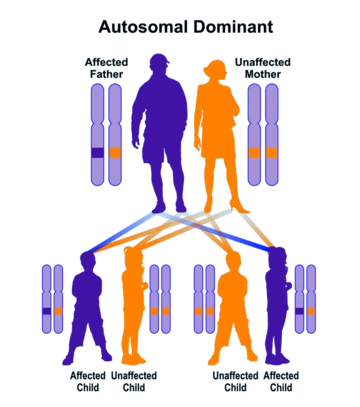
Autosomal dominant inheritance leads to a vertical pattern of transmission
Autosomal recessive
In order for autosomal recessive disorders to be expressed, offspring generally must inherit two mutations, one from each carrier parent. Carriers with only one mutation, such as the parents, do not have clinical disease. Note that carrier parents can expect that 1 in 4 children (25%) will inherit both mutations and have the disorder, 2 in 4 children (50%) will be carriers like their parents, while 1 in 4 children (25%) inherit neither mutation.

In order for autosomal recessive disorders to be expressed, offspring generally must inherit two mutations, one from each carrier parent. Carriers with only one mutation, such as the parents, do not have clinical disease. Note that carrier parents can expect that 1 in 4 children (25%) will inherit both mutations and have the disorder, 2 in 4 children (50%) will be carriers like their parents, while 1 in 4 children (25%) inherit neither mutation.