


Acrofacial Dysostosis, Cincinnati Type
Patient Information
Characteristics
Background and History
This is a hereditary malformation syndrome that primarily involves the face.
Clinical Correlations
The anomalous facial features are present at birth. The head is often small. The lower jaw can be severely underdeveloped requiring a breathing tube (tracheostomy) in the newborn period. The external ears (pinnae) appear large and sometimes have no opening resulting in severe hearing loss. The eyes themselves appear to be lower than normal and the openings between the eyelids (lid fissures) may slant downwards. The lower lids and sometimes the upper can have ‘clefts’ (colobomas). The bones of the midface are underdeveloped resulting in a flattened appearance. Older children are often small in stature.
Only a few individuals with this syndrome have been reported.
Genetics
Inheritance
This is an autosomal dominant condition caused by a mutation in a specific gene. It can be passed from affected parent to a child with a 50% probability.
Pedigree
Autosomal dominant
Autosomal dominant disorders require only one mutation for the disease to be expressed. Since an affected parent has two chromosomes, only one of which has the mutant gene, parents can expect that half (50%) of their children will receive that one and inherit the disease. It is common for individuals that inherit the mutation, however, to not have evidence of the disease (nonpenetrance).
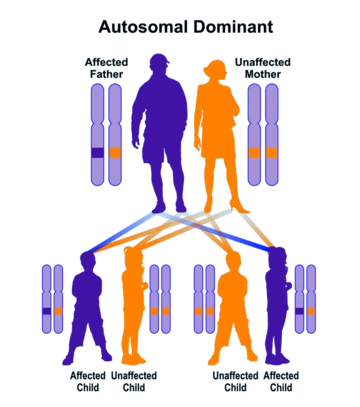
Autosomal dominant inheritance leads to a vertical pattern of transmission
Diagnosis and Prognosis
The diagnosis can be made at birth but the rarity of this condition makes it difficult. A pediatrician, pediatric geneticist, or a dysmorphologist can be helpful.
No treatment is available for the general condition but individual features such as the lid colobomas could be surgically treatable. The impact on longevity is unknown.
Printer Friendly Version: Ctrl/Cmd+P