


OMIM ID:
Acrofacial Dysostosis, Cincinnati Type
Alternate Names
Defective Genes
Clinical Characteristics
Ocular Features
The periocular features are part of the general facial dysmorphism. The lid fissures slant downward, and the orbits appear inferiorly displaced. 'Clefts' (colobomas?) of the lower eyelids and sometimes the upper may be evident. The medial eyelashes were absent in one patient.
Systemic Features
The extraocular features reported so far are based on only three patients and there is considerable variation. The head is usually small and patients may be short in stature. The zygomatic arches, the maxillae and the mandibles are hypoplastic as is the midface. There may be anotia and severe conductive hearing loss. The pinnae can be large and are sometimes low-set. Inconsistent short limbs with hip dysplasia and femoral bowing have been reported. Brachydactyly is also a feature.
Genetics
Inheritance
Heterozygous mutations in the POLR1A gene (2p11) seem to be responsible for this condition.
Pedigree
Autosomal dominant
Autosomal dominant disorders require only one mutation for the disease to be expressed. Since an affected parent has two chromosomes, only one of which has the mutant gene, parents can expect that half (50%) of their children will receive that one and inherit the disease. It is common for individuals that inherit the mutation, however, to not have evidence of the disease (nonpenetrance).
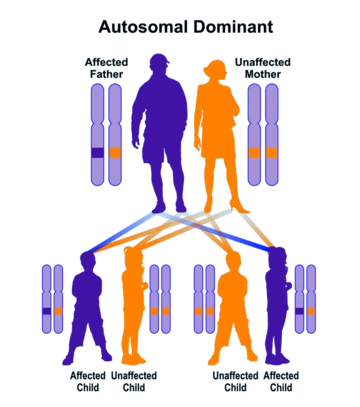
Autosomal dominant inheritance leads to a vertical pattern of transmission