


OMIM ID:
Sweeney-Cox Syndrome
Alternate Names
Defective Genes
Clinical Characteristics
Ocular Features
Periorbital and facial anomalies were present in the two reported patients. Pseudoproptosis (considered secondary to deficiency of the bony orbits) accentuated by midface hypoplasia, and upper lid colobomas have been observed. The globes were described as “small” although there were no “concerns” regarding vision in the single male patient. Electrodiagnostic tests were “normal.”
Systemic Features
Multiple anomalies and malformations were present in the two reported patients, an unrelated male and female. Severe facial dysmorphism secondary to uneven skull bone formation and suture closures is present. The metopic ridge is prominent, the orbital bones are deficient, the occiput is flattened, the anterior fontanel and coronal sutures are wide. Midfacial hypoplasia is present. The neck is broad and the shoulders are narrow. The fingers are long and the distal phalanges may be fixed in flexion. The ears are low-set, small, and cupped. The palate is high and may be cleft. Cutaneous syndactyly of the fingers has been observed. Variable developmental delays/learning difficulties are present.
The male had an imperforate anus, undescended testes and a 60 dB hearing loss. The female had a midline cleft palate with choanal atresia requiring a tracheostomy from birth and required fundoplication and gastrostomy for gastroesophageal reflux.
Genetics
Inheritance
Heterozygous missense mutations in the TWIST1 gene (7p21.1) were found in both reported individuals. These appear to have arisen de novo.
Mutations in the same gene have also been found in the Saethre-Chotzen Syndrome (101400) in which some of the same skeletal features are found.
Pedigree
Autosomal dominant
Autosomal dominant disorders require only one mutation for the disease to be expressed. Since an affected parent has two chromosomes, only one of which has the mutant gene, parents can expect that half (50%) of their children will receive that one and inherit the disease. It is common for individuals that inherit the mutation, however, to not have evidence of the disease (nonpenetrance).
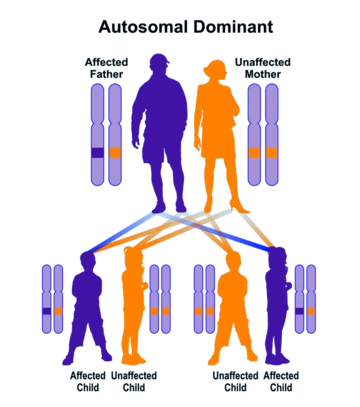
Autosomal dominant inheritance leads to a vertical pattern of transmission