


OMIM ID:
Spastic Paraplegia, Intellectual Disability, Nystagmus, and Obesity
Alternate Names
Defective Genes
Clinical Characteristics
Ocular Features
Patients have deep-set eyes with nystagmus, reduced vision, and often an esotropia perhaps secondary to hypermetropia. In one of 3 reported patients the optic discs were described pale.
Systemic Features
Prominent foreheads are present at birth along with full cheeks and a prominent forehead. Children grow rapidly in the first year eventually reaching the 90th percentiles in weight, height, and head circumference although neurologically they are developmentally delayed. Speech and walking may be delayed as well. While limbs have increased tone together with hyperreflexia, the trunk exhibits hypotonia.
Brain imaging reveals delayed myelination, dilated lateral ventricles, reduced while matter, and cerebral atrophy.
Genetics
Inheritance
Heterozygous mutations in the KIDINS220 gene (2p25.1) have been identified in 3 unrelated patients.
Pedigree
Autosomal dominant
Autosomal dominant disorders require only one mutation for the disease to be expressed. Since an affected parent has two chromosomes, only one of which has the mutant gene, parents can expect that half (50%) of their children will receive that one and inherit the disease. It is common for individuals that inherit the mutation, however, to not have evidence of the disease (nonpenetrance).
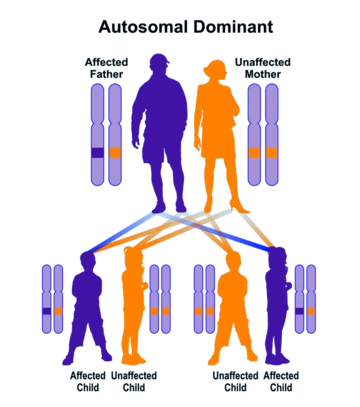
Autosomal dominant inheritance leads to a vertical pattern of transmission