


Spastic Paraplegia, Intellectual Disability, Nystagmus, and Obesity
Patient Information
Characteristics
Background and History
This rare inherited syndrome has been reported in 3 unrelated patients.
Clinical Correlations
Newborns have deep-set eyes and a prominent forehead with chubby cheeks. They grow rapidly in infancy and approach the 90th percentile in weight and height in the first year of life. Obesity may be an issue. They often have some floppiness in their trunk (central body) but the limbs can be stiff with increased reflexes. They are intellectually delayed and may not be able to speak or walk until mid-childhood.
Brain imaging (MRI) shows delayed maturation of various structures.
The eyes may not be properly aligned (strabismus) and often have a constant to-and-fro motion (nystagmus). Vision is generally poor.
Genetics
Inheritance
This is an autosomal dominant disorder caused by a change (mutation) in a specific gene. Three unrelated children have been reported must likely due to a new mutation since affected individuals are too severely delayed to reproduce and the gene change cannot be transmitted.
Pedigree
Autosomal dominant
Autosomal dominant disorders require only one mutation for the disease to be expressed. Since an affected parent has two chromosomes, only one of which has the mutant gene, parents can expect that half (50%) of their children will receive that one and inherit the disease. It is common for individuals that inherit the mutation, however, to not have evidence of the disease (nonpenetrance).
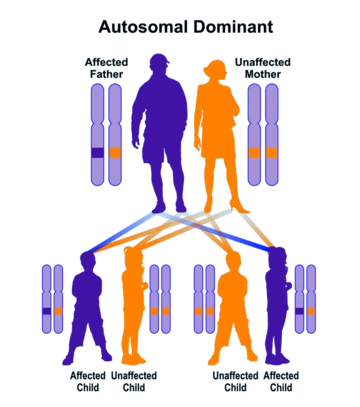
Autosomal dominant inheritance leads to a vertical pattern of transmission
Diagnosis and Prognosis
The diagnosis can be suspected at birth based on the facial morphology although the signs are not specific. It is likely that pediatricians and neurologists would collaborate on the diagnostic evaluation and supportive care required. The eye signs should be evaluated by a medical eye doctor (ophthalmologist).
No treatment has been reported. Strabismus can be surgically corrected although the potential benefits should be discussed on an individual basis with the family. Obesity treatment is not useful generally.
Nothing is known regarding longevity.
Printer Friendly Version: Ctrl/Cmd+P