


OMIM ID:
Singleton-Merten Syndrome 2
Alternate Names
Defective Genes
Clinical Characteristics
Ocular Features
Glaucoma has been diagnosed in multiple members of 4 a generation Korean family in which various features of this disorder were found. The glaucoma is likely congenital in origin as it has been diagnosed in patients as young as 3 years of age
Systemic Features
Calcification of the aorta and other large vessels may be identified in childhood. The aortic valve and coronary arteries may become calcified in young adults as well, sometimes resulting in aortic stenosis. Arthritis resulting from calcified tendons as well as ligaments of the interphalangeal and metacarpophalangeal joints may occur in young adults. The skin is often scaly and dry with psoriatic lesions. The terminal tufts of the digits have evidence of erosion.
Genetics
Inheritance
Heterozygous mutations in the DDX58 gene (9p21.1) have been associated with this disorder. Some of the clinical features overlap those of Singleton-Merten Syndrome 2 (182250) but this is a unique disorder caused by a different mutation (IFIH1).
Pedigree
Autosomal dominant
Autosomal dominant disorders require only one mutation for the disease to be expressed. Since an affected parent has two chromosomes, only one of which has the mutant gene, parents can expect that half (50%) of their children will receive that one and inherit the disease. It is common for individuals that inherit the mutation, however, to not have evidence of the disease (nonpenetrance).
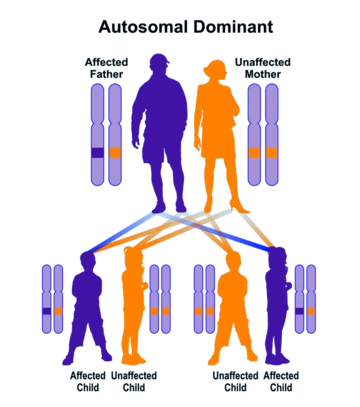
Autosomal dominant inheritance leads to a vertical pattern of transmission