


OMIM ID:
Retinitis Pigmentosa 42
Alternate Names
Defective Genes
Clinical Characteristics
Ocular Features
The fundus phenotype of retinitis pigmentosa appears late. Night vision difficulties are prominent symptoms but the age of onset is unknown. Reduction in visual acuity is variable and is usually not manifest until 50 years of age but it may remain near normal or in that range for another decade or two. Concentric constriction (within 10-20 central degrees) in peripheral fields can be a presenting symptom and may not appear until age 65 years of age. Patches of visual field retention can sometimes be demonstrated in the periphery. Rod and cone full field ERG amplitudes are substantially reduced
Systemic Features
None.
Genetics
Inheritance
Pedigree
Autosomal dominant
Autosomal dominant disorders require only one mutation for the disease to be expressed. Since an affected parent has two chromosomes, only one of which has the mutant gene, parents can expect that half (50%) of their children will receive that one and inherit the disease. It is common for individuals that inherit the mutation, however, to not have evidence of the disease (nonpenetrance).
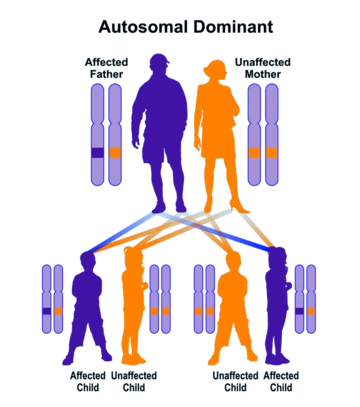
Autosomal dominant inheritance leads to a vertical pattern of transmission