


OMIM ID:
Neurodevelopmental Disorder With or Without Seizures and Gait Abnormalities
Alternate Names
Defective Genes
Clinical Characteristics
Ocular Features
Nystagmus and strabismus are common ocular features. Optic nerve hypoplasia is present in some individuals.
Systemic Features
Symptoms may begin in early infancy or childhood. Several neonates with irritability, hypertonia, increased startle reflexes, and stiffness have been reported. Hypotonia may occur in the neonatal period though. Intellectual disability and severe developmental delay are common and some patients are unable to follow simple commands. Seizures of variable severity frequently occur at some point. Speech may be absent. Some patients are unable to walk while those that do have a clumsy, spastic gait. Joint contractures may develop.
The most obvious dysmorphic feature are large ears. Choreiform and stereotypic hand movements are sometimes present. Feeding difficulties and sleeping problems may be noted. Cortical atrophy and thinning of the corpus callosum has been seen on brain imaging. One mildly affected individual was short in stature.
Genetics
Inheritance
Heterozygous mutations in the GRIA4 gene (11q22.3) have been found in 5 unrelated patients.
Pedigree
Autosomal dominant
Autosomal dominant disorders require only one mutation for the disease to be expressed. Since an affected parent has two chromosomes, only one of which has the mutant gene, parents can expect that half (50%) of their children will receive that one and inherit the disease. It is common for individuals that inherit the mutation, however, to not have evidence of the disease (nonpenetrance).
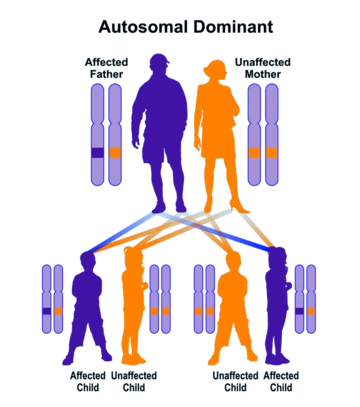
Autosomal dominant inheritance leads to a vertical pattern of transmission