


OMIM ID:
Mental Retardation, AD 57
Alternate Names
Defective Genes
Clinical Characteristics
Ocular Features
Ptosis, strabismus, epicanthal folds, and upslanting lid fissures are often present but there is considerable variation among individuals. Blepharophimosis, telecanthus, and various refractive errors have also been reported.
Systemic Features
There is great variability in the clinical signs among patients. Most have developmental delays and intellectual disabilities combined with behavioral challenges such as anxiety, obsessive-compulsive disorders and features of autism spectrum disorders.
Infants and young children may have feeding difficulties but may later develop constipation or diarrhea.
Skeletal anomalies such as short stature, high palate, craniosynostosis, scoliosis, pes planus, hand contractures, and joint hypermobility have been reported. The voice may be hoarse.
Genetics
Inheritance
Heterozygous mutations in the TLK2 gene (17q23) are responsible for this condition.
Pedigree
Autosomal dominant
Autosomal dominant disorders require only one mutation for the disease to be expressed. Since an affected parent has two chromosomes, only one of which has the mutant gene, parents can expect that half (50%) of their children will receive that one and inherit the disease. It is common for individuals that inherit the mutation, however, to not have evidence of the disease (nonpenetrance).
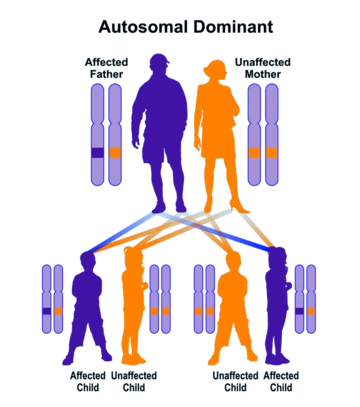
Autosomal dominant inheritance leads to a vertical pattern of transmission