


Clinical Characteristics
Ocular Features
Marfan syndrome typically has skeletal, ocular and cardiovascular abnormalities. The globe is elongated creating an axial myopia and increasing the risk of rhegmatogenous retinal detachments. Ectopia lentis is, of course, the classical ocular feature and is often if not always congenital with some progression. The lenses most frequently dislocate superiorly and temporally and dilating the pupils often reveals broken and retracted lens zonules. Phacodenesis and iridodenesis are commonly present even in the absence of evident lens dislocations. Cataracts develop several decades earlier than in unaffected individuals. The cornea is generally several diopters flatter than normal and there is an increased risk of open angle glaucoma. There is considerable clinical variation among patients.
Systemic Features
Patients with the Marfan phenotype are usually tall with disproportionately long limbs (dolichostenomelia) and digits (arachnodactyly). Patients frequently have scoliosis or kyphoscoliosis. The joints are lax and hyperflexible although contractures can also occur. The sternum is often deformed, either as a pectus excavatum, or sometimes pectus carinatum. The hard palate is high and narrow resulting in crowding of the teeth and maloccclusion. The defect in fibrillin is responsible for the weakness in connective tissue that leads to frequent cardiac valve malfunction, especially insufficiency of the aortic valve resulting from aortic dilatation, tear, and rupture. The latter is often life-threatening as aortic dissection can be fatal. Mitral valve prolapse is seen as well. Cardiovascular disease is primarily responsible for the shortened life expectancy in this disease, more pronounced among males.
Genetics
Inheritance
As many as 25% of cases are caused by new mutations, but familial cases usually follow an autosomal dominant pattern of inheritance. Autosomal recessive inheritance is claimed for several individuals in a consanguineous Turkish family. Mutations in the fibrillin-1 gene (FBN1) on chromosome 15 (15q21.1) are considered responsible for the typical phenotype. The exact nature of the fibrillin defect is unknown but the result is a generalized weakness in connective tissue.
The same gene is mutant in the autosomal dominant form of the Weill-Marchesani syndrome (608328) which is allelic to the Marfan syndrome.
Mutations in FBN1 have also been found in cases with isolated autosomal dominant ectopia lentis (129600).
Pedigree
Autosomal dominant
Autosomal dominant disorders require only one mutation for the disease to be expressed. Since an affected parent has two chromosomes, only one of which has the mutant gene, parents can expect that half (50%) of their children will receive that one and inherit the disease. It is common for individuals that inherit the mutation, however, to not have evidence of the disease (nonpenetrance).
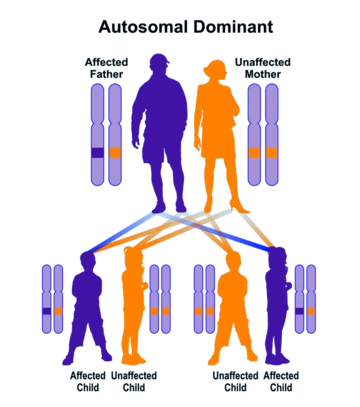
Autosomal dominant inheritance leads to a vertical pattern of transmission