


OMIM ID:
Macular Dystrophy, Vitelliform 1
Alternate Names
Defective Genes
Clinical Characteristics
Ocular Features
This is an uncommon form of vitelliform macular dystrophy and may not be a unique disorder. Onset of disease is usually later than in the classic Best disease due to mutations in the Best1 gene. Only slight to moderate vision impairment is present. Small drusen-like lesions may be seen in the foveal areas along with macular or extramacular punctate yellow lesions. Importantly, the EOG light/dark Arden ratio is often normal or only slightly impacted even when severe loss of vision is present. It has been claimed that fundus fluorescein angiography is diagnostically more reliable than the EOG. Patchy RPE depigmentation is often present in the central and the peripheral retina as well as in the peripapillary area.
The clinical features resemble vitelliform macular dystrophy resulting from mutations in the IMPG1 and IMPG2 genes.
Systemic Features
No systemic abnormalities have been reported.
Genetics
Inheritance
No mutation or locus has been found to segregate with VMD1 disease. However, it is probably a unique condition since other VMD-causing mutations such as those in Best1, PRPH2, IMPG1, and IMPG2 have been ruled out in a number of families.
The transmission pattern is consistent with autosomal dominant inheritance.
Genotyping has identified at least 5 forms of vitelliform macular dystrophy. In addition to the iconic Best disease (VMD2, 153700) apparently first described by Friedreich Best in 1905 and now attributed to mutations in the Best1 gene, we know of at least 4 more and specific mutations have been identified in three. Other forms are VMD3 (608161) due to mutations in the PRPH2 gene, VMD4 (616151) resulting from mutations in the IMPG1 gene, and VMD5 (616152) caused by mutations in the IMPG2 gene.
Pedigree
Autosomal dominant
Autosomal dominant disorders require only one mutation for the disease to be expressed. Since an affected parent has two chromosomes, only one of which has the mutant gene, parents can expect that half (50%) of their children will receive that one and inherit the disease. It is common for individuals that inherit the mutation, however, to not have evidence of the disease (nonpenetrance).
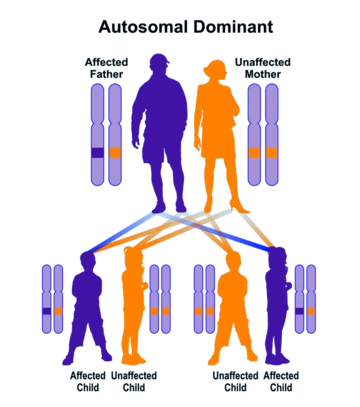
Autosomal dominant inheritance leads to a vertical pattern of transmission